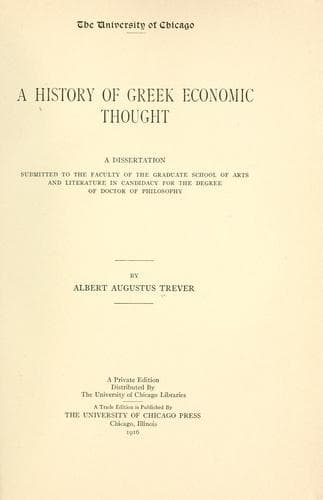
A History of Greek Economic ThoughtTrever, Albert Augustus
History
A History of Greek Economic Thought
Trever, Albert Augustus
Economics -- Greece -- History; Thesis (Ph. D.)
_Econ._ vi. 4; cf. i. 7 ff., cited above, p. 64, n. 1.
Footnote 389:
P. 64 and notes. Büchsenschütz (_Besitz und Erwerb_, p. 15) criticizes
it as too broad, including spiritual goods; too narrow, including only
what one can use.
Footnote 390:
In _Econ._ ii. 2-8, Socrates’ comparison of himself with the wealthy
Critoboulos; _Hiero_ iv. 6-10; _Mem._ iv. 2. 37 f.; i. 6. 1-10, where
Socrates defends his own simple life, especially 10: ἐγὼ δ᾽ ἐνόμιζον
τὸ μὲν μηδενὸς δεῖσθαι θεῖον εἶναι. If meant in the economic sense,
this would approach a definition of capital, as “excess of goods over
needs.”
Footnote 391:
Cf. p. 25, n. 11, on the similar modern doctrine.
Footnote 392:
_Symp._ iii. 8 and iv. 34-44, given as the doctrine of Antisthenes,
the Cynic, though with apparent approval; _Mem._ iv. 2. 9.
Footnote 393:
_Econ._ xi. 9.
Footnote 394:
_Cyrop._ viii. 2. 23.
Footnote 395:
_Mem._ ii. 7. 7; _Rev._ iv. 29.
Footnote 396:
Thuc. vii. 6. 2, of walls; _Gorg._ 449D, ἱματίων; _Theaet._ 146D,
ὑποδημάτων; Xen. _Econ._ vii. 21, ἐσθῆτος.
Footnote 397:
Hdt. i. 68; _Charm._ 173E; Thuc. iv. 105.
Footnote 398:
Ar. _Frogs_ 1034; Isoc. _Areop._ 30.
Footnote 399:
Isoc. _Areop._, 146_d_, cited _infra_ on the terms for capital; _Ad
Nicocl._ 18C.
Footnote 400:
_Mem._ iii. 10. 1; Dem. xxxiii. 4.
Footnote 401:
_C.I.A._ 3924: ἡ ἐργασία τῶν βαφέων.
Footnote 402:
Ar. _N. Eth._ vi. 4. 2 ff.
Footnote 403:
_Op. cit._, 1st ed., p. 55.
Footnote 404:
_Econ._, especially chaps. v-vii; iv. 4; _Mem._ ii. 1. 6; _Econ._ v.
17: εὒ μὲν γὰρ φερομένης τῆς γεωργίας ἔρρωνται καὶ ἄλλαι τέχναι
ἄπασαι, ὅπου δ᾽ ἂν ἀναγκασθῇ ἡ γῆ χερσεύειν, ἀποσβέννυνται καὶ αἱ
ἄλλαι τέχναι σχεδόν τι καὶ κατὰ γῆν καὶ κατὰ θάλατταν, a very true
statement, which does not belittle other industries.
Footnote 405:
_Ibid._ v. 2; iii. 15. 11, 16; _Rev._ i. 2 ff., etc.
Footnote 406:
_Pol._ i. 8 and 9.
Footnote 407:
_Mem._ ii. 7. 13 f., from Socrates. Cf. _infra_ under distribution, on
this.
Footnote 408:
_Rev._ iv. 5-7; Cossa, _op. cit._, p. 148; Kautz, _Histoire des
doctrines économiques_, p. 127; Fontpertuis, _op. cit._, p. 367.
Footnote 409:
_Econ._ v. 17, cited on p. 66, n. 11, perhaps the strongest statement
of the economic importance of agriculture in Greek writers. Ruskin
follows Xenophon in his high appreciation of agriculture. He thinks it
should be largely done by the upper classes (_Mun. Pul._, 109 [Vol.
XVII, 235]); cf. also Vol. VII, 341, 429; Vol. X, 201.
Footnote 410:
_Econ._ iv. 4; cf. _Rev._ v. and _Cyrop._ iii. 2. 17, which favor
peace for the sake of economic advance.
Footnote 411:
_Econ._ iv. 8 to end of chapter, especially 21.
Footnote 412:
_Econ._, v. 1; 2-16; vi. 9-10; cf. Fontpertuis, _op. cit._, pp. 362 f.
Footnote 413:
_Econ._ vi. 8.
Footnote 414:
Cf. _Revenues_.
Footnote 415:
Public-domain text, read in full here on John Shaqi.
Reviews
Reviews
No reviews yet
Be the first to share your thoughts on this work.
Elsewhere in the archive
Join the Discussion
Join the discussion
Sign in to leave a comment or review.
Sign InorCreate an account