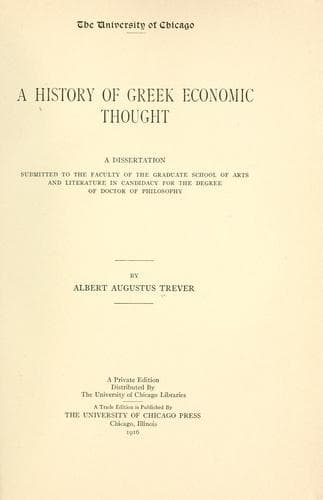
A History of Greek Economic ThoughtTrever, Albert Augustus
History
A History of Greek Economic Thought
Trever, Albert Augustus
Economics -- Greece -- History; Thesis (Ph. D.)
The positive interest of Demosthenes in commerce and finance has already
been indicated by some passages,[487] and this fact is so evident
throughout all his orations that further citations are unnecessary.
Instead, we may note briefly some slight hints in him of the negative
moral attitude of the philosophers. He emphasizes the dominating
influence of money in warping the judgments of men.[488] He praises the
simple life of the previous generation, and criticizes in contrast the
private luxury of his own day.[489] According to him, it is considered
to be rare for a business man to be both diligent (φιλεργόν) and honest
(χρηστόν).[490] In his assertion that poverty compels freemen to turn to
menial work (δουλικά) and that many freewomen (ἀσταί) have been driven
by the stress of the times to such vocations,[491] some aristocratic
prejudice against common labor seems to be implied. A similar attitude
toward traders and money-dealers is at least suggested by his question
as to what is the worst (πονηρότατον) element in the state.[492] His
scornful mention of Stephanus as one who loans money at interest, and
takes advantage of another’s need,[493] is a slight reminder of the
philosophic prejudice against interest, though here he is doubtless
emphasizing loans for consumption merely, at an exorbitant rate.[494]
But these traces of the Socratic attitude toward wealth are of very
little significance, in the face of the evident economic interest that
characterizes all the orations of Demosthenes.
Isocrates may, in a sense, be reckoned among the Socratics, and he
exhibits more of their spirit in relation to wealth than do any of the
other orators. He would have men strive for honest character rather than
for wealth, since it is not always gain to acquire and loss to spend.
The result depends rather upon the occasion and virtue.[495] Noble
character is of more value than great riches,[496] for good reputation
is not purchasable (ὠνητή) with money, but is itself the source of
material possessions, and it is immortal, while wealth is only
temporal.[497] Material and spiritual wealth are thus contrasted in true
Socratic manner;[498] right use is emphasized,[499] and the common
insatiety and injustice of money-makers is opposed.[500] Folly and
license are named as the usual accompaniments of wealth, in contrast to
the moderation that characterizes the poor and lowly.[501] But, like
Plato, Isocrates considers neither luxury nor penury to be the ideal
condition,[502] and clearly appreciates the evil effect of poverty in
arousing discontent and civic strife in the state.[503]
Public-domain text, read in full here on John Shaqi.
Reviews
Reviews
No reviews yet
Be the first to share your thoughts on this work.
Elsewhere in the archive
Join the Discussion
Join the discussion
Sign in to leave a comment or review.
Sign InorCreate an account