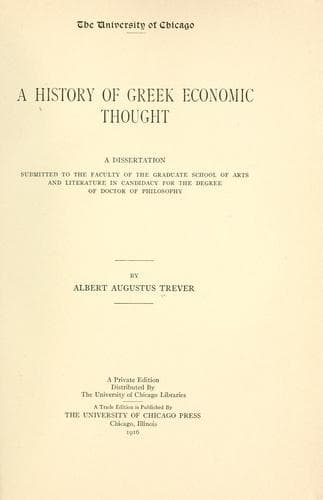
A History of Greek Economic ThoughtTrever, Albert Augustus
History
A History of Greek Economic Thought
Trever, Albert Augustus
Economics -- Greece -- History; Thesis (Ph. D.)
_Rev._ iv. 17; cf. p. 70; but p. 69 might point the other way.
Footnote 474:
_Mem._ iv. 4. 16; ἄνευ δὲ ὁμονοίας οὐτ᾽ ἂν πόλις εῦ πολιτευθείν οὐτ᾽
οἶκος καλῶς, οἰκηθείν.
Footnote 475:
_Econ._ xi. 9, 13.
Footnote 476:
Cf. how naïvely he takes for granted the feasibility of his schemes in
the _Revenues_. Cf. the opening sentence of the work, “As are the
governors [προστάται], so are the governments [πολιτείας]” cited by
Poehlmann (_op. cit._, I, 299) as the illusion of socialism; but it
might easily be expressed by a conservative. Plato (_Rep._ 544D)
expresses a similar idea.
Footnote 477:
_Rev._ iii and iv.
Footnote 478:
iv. 33. The mines were already publicly owned, for the most part, but
they were privately worked. Cf. Ardaillon, _Les Mines du Laurion dans
l’antiquité_ (Paris, 1897).
Footnote 479:
iii. 14.
Footnote 480:
iv. 17.
Footnote 481:
iv.
Footnote 482:
iv. 49.
Footnote 483:
iii. 9 f.
Footnote 484:
iv. 30-32.
Footnote 485:
iv. 33; 49-52; vi. 1. Cf. the excellent résumé of the whole plan by
Poehlmann (_op. cit._, I, 299 ff.), though he reads into it too much
of the modern socialistic spirit; e.g., 306-8, he makes it an example
of the so-called psychological necessity by which socialism develops
out of capitalism.
Footnote 486:
Cf. especially iv. 14: τῆς μέντοι πόλεως πάνυ ἄξιον θαυμάσαι τὸ
αἰσθανομένην πολλοὺς πλουτιζομένους ἕξ αὐτῆς ἰδιώτας μὴ μιμεῖσθαι
τούτους.
CHAPTER V
THE ORATORS—DEMOSTHENES, ISOCRATES
Though the Attic orators constitute a very important source for our
knowledge of economic conditions in Athens, they furnish but little
definite material for a history of Greek economic thought. From the
standpoint of theory, their chief value consists in the fact that they
all reveal a positive interest in wealth and all the phenomena of
practical economy. In this respect, they present a striking contrast to
the negative attitude of the Socratics, and thus serve to correct our
conception of the economic ideas of the average Athenian citizen.
Specific consideration need be given only to Demosthenes and Isocrates.
Public-domain text, read in full here on John Shaqi.
Reviews
Reviews
No reviews yet
Be the first to share your thoughts on this work.
Elsewhere in the archive
Join the Discussion
Join the discussion
Sign in to leave a comment or review.
Sign InorCreate an account