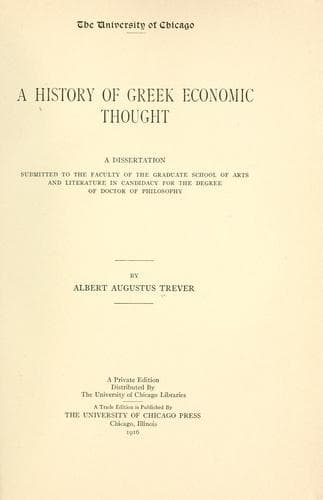
A History of Greek Economic ThoughtTrever, Albert Augustus
History
A History of Greek Economic Thought
Trever, Albert Augustus
Economics -- Greece -- History; Thesis (Ph. D.)
Xen. _Mem._ iii. 4. 6 ff., especially 12; _Econ._ xx; Plato _Pol._ 259
B-C; cf., on this passage, Espinas, _Revue des Etudes Grecques_, XXVII
(1914), 105; cf. Ruskin: “Economy no more means saving money than it
means spending money. It means the administration of a house” (_A Joy
Forever_, I, 8, Allen ed., London, 1912, Vol. XVI, 19). We shall
frequently quote from this monumental edition of Ruskin.
Footnote 6:
_Pol._ i. 1. 2: ὅσοι μὲν οὖν οἵονται πολιτικὸν καὶ βασιλικὸν καὶ
οἰκονομικὸν καὶ δεσποτικὸν εἶναι τὸν αὐτόν, οὐ καλῶς λέγουσιν.
Footnote 7:
_Political Thought of Plato and Aristotle_, p. 357; cf. Zmavc,
_Zeitschr. f. d. gesammt. Staatswissenschaft_, 1902, pp. 59 f., and
his references to Boeckh, Meyer, and Beloch; Kautz, _Die Gesch. d.
Entwickelung der National Ökonomik_, p. 133, n. 5; for note on the
authorship of the _Revenues_, cf. _infra_, p. 63, n. 2.
Footnote 8:
Ingram, _History of Political Economy_, p. 12; cf. Souchon, _Les
Théories économiques dans la Grèce antique_, p. 34.
Footnote 9:
Cf. Souchon, _op. cit._, pp. 31 ff.
Footnote 10:
Cf. V. Brants, _Xenophon Economiste_, reprint from _Revue Catholique
de Louvain_, 1881, pp. 4 ff.
Footnote 11:
Ely, _Studies in Historical and Political Science_, 2d series, pp. 48
ff., especially p. 64, where he states that it is a return to the
Greek view.
Footnote 12:
Ely, _Outlines of Economics_, 1908, pp. 4 ff.; cf. Seligman,
_Principles of Economy_, (1905), pp. 4 ff., especially p. 14, where he
even quotes the sentences of Ruskin with approval: “There is no wealth
but life”; “Nor can anything be wealth except to a noble person”
(_Unto This Last_, IV, 77 [Vol. XVII, 105]). All citations will be
from the Allen library edition unless otherwise stated.
Footnote 13:
Schoenberg, _Handbuch der polit. Econ._ (1890), I, 56.
Footnote 14:
Haney, _History of Economic Thought_, p. 52; cf. Ely, _op. cit._, p.
48, n. 1, cited in n. 1, above, for a similar definition based on
Plato.
Footnote 15:
Kautz (_op. cit._, p. 57) goes to the extreme of saying that antiquity
represents “die Negation der ökonomischen Interessen und der
wirtschaftlichen Arbeit.”
Footnote 16:
Even abolition of debts and redivision of lands were not unknown in
Greek history. Grote (_History of Greece_, III, 105 f. and notes)
denies this, but the heliastic oath, which he cites (Dem. _Adv.
Timoc._ 746, and Dio Chrysost. Or. xxxi. 332), proves that such
measures were agitated, or there would be no reason for protective
measures. Cf. _infra_, Plato (_Laws_, 736E), who takes this for
granted. Cf. Solon’s Fragments; Isoc. (_Panath._ 259) says that it
would be hard to find a Greek state, except Sparta, that has not
fallen into “the accustomed accidents,” viz., στάσιν, σφαγάς, φυγὰς
ἀνόμους, ἁρπαγὰς χρημάτων, χρεῶν ἀποκοπάς, γῆς ἀναδασμόν, etc.
Footnote 17:
Cf. _infra._ for citations and qualifications.
Public-domain text, read in full here on John Shaqi.
Reviews
Reviews
No reviews yet
Be the first to share your thoughts on this work.
Join the Discussion
Join the discussion
Sign in to leave a comment or review.
Sign InorCreate an account