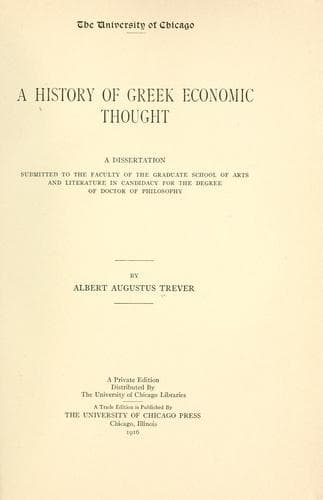
A History of Greek Economic ThoughtTrever, Albert Augustus
History
A History of Greek Economic Thought
Trever, Albert Augustus
Economics -- Greece -- History; Thesis (Ph. D.)
There is a certain economic and moral truth, also, in the attitude of
Aristotle toward slavery, that, as Ruskin has observed,[671] higher
civilization and culture must have a foundation of menial labor, and
that the only justification of such a situation is in the assumption
that some are naturally fitted for the higher, and some for the lower,
sphere.[672] Such modern laborers are not technically slaves, but
Aristotle would insist that they are in a still worse condition, since
they are deprived of the humanizing and moralizing influences of a
rational master. The plausibility of such a contention would be well
illustrated by the wretched condition of multitudes of negroes after the
Civil War, as also by the hopeless life of a large portion of the modern
industrial army. Moreover, the economic slavery of many of the common
toilers today is less justifiable than the domestic slavery advocated by
Aristotle, for it too often means a life of indolence and
self-indulgence for the masters, instead of that Greek leisure which
gave opportunity for higher activity.[673]
MONEY
To the theory of money Aristotle makes a substantial contribution. He
agrees with Plato that money found its origin in the growth of necessary
exchange, which in turn resulted from an increased division of labor.
Unlike Plato, however, he gives a detailed history of the development of
money.[674] Before its invention, all exchange was by barter.[675] But
with the growth of commerce, barter became difficult, and a common
medium of exchange was agreed upon.[676] Something was chosen that was a
commodity, having intrinsic value (ὁτῶν χρησίμων αὐτὸ ὄν) and that was
easy to handle (εὐμεταχείριστον) in the business of life such as iron,
silver, or other metal.[677] It was first uncoined, defined merely by
size and weight.[678] Finally, to avoid the inconvenience, it was given
a stamp (χαρακτήρ) representative of the quantity (σημεῖον τοῦ
πόσου).[679] Thus arose the use of money as a convenience in necessary
exchange, but once having arisen, it became the foundation of false
finance and retail trade, which are pursued as a science of gain.[680]
All this accords well with the facts as now accepted, yet how utterly
different is Aristotle’s standpoint from that of the modern historian of
economic institutions is revealed by his last statement, and indeed by
the setting of the entire passage. His history of money is merely
incidental to his purpose of showing that money is the parent and the
very life of the false finance which he decries.
Public-domain text, read in full here on John Shaqi.
Reviews
Reviews
No reviews yet
Be the first to share your thoughts on this work.
Elsewhere in the archive
Join the Discussion
Join the discussion
Sign in to leave a comment or review.
Sign InorCreate an account