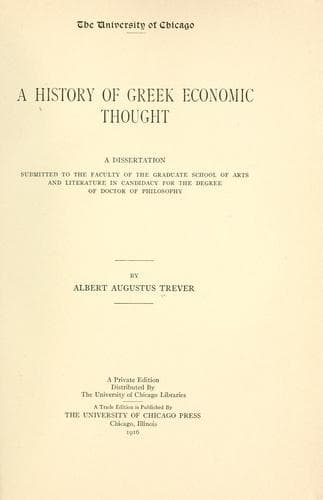
A History of Greek Economic ThoughtTrever, Albert Augustus
History
A History of Greek Economic Thought
Trever, Albert Augustus
Economics -- Greece -- History; Thesis (Ph. D.)
He is also more explicit than the other Greek theorists on the function
of money. He clearly recognizes the two functions noted by Plato,[681]
but he deals with them in a much more detailed manner. His discussion
grows out of his theory of distributive justice presented in the
_Ethics_.[682] Money was introduced as the exchangeable representative
of demand (ὑπάλλαγμα τῆς χρείας),[683] since diverse products must be
reduced to some common denominator.[684] It is thus a medium of
exchange, acting as a measure of all inferior and superior values, by
making them all commensurable (συμβλητά).[685]
The other important function of money recognized is as a guaranty
(ἐγγυητής) of future exchange. It represents the abiding, rather than
the temporary, need, and is thus a standard of deferred payments.[686]
The importance of money in the fulfilment of these functions is great,
in the opinion of Aristotle. The possibility of fair exchange, or indeed
the very existence of organized society depends upon it.[687]
He is also clearer than Plato and Xenophon in his definition of the
relation between money and wealth. He severely criticizes the current
mercantilistic theory of his day, which identified wealth with a
quantity of current coin (νομίσματος πλῆθος).[688] He immediately
follows this, however, with a more extended presentation of the opposite
error of the Cynics, that money is mere trash (λῆρος), depending for its
value entirely upon convention (νόμῳ). This theory, he points out, is
based on the fact that, if money ceased to be recognized as legal
tender, it would be useless; that it satisfies no direct necessity; and
that one might starve like Midas, though possessed of it in
superabundance.[689]
Public-domain text, read in full here on John Shaqi.
Reviews
Reviews
No reviews yet
Be the first to share your thoughts on this work.
Elsewhere in the archive
Join the Discussion
Join the discussion
Sign in to leave a comment or review.
Sign InorCreate an account