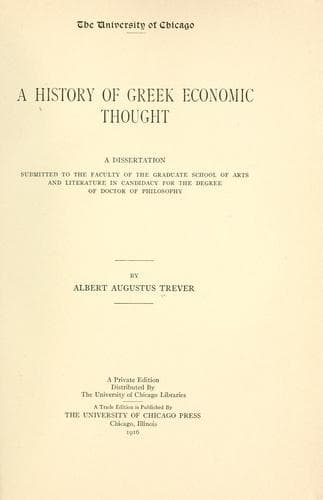
A History of Greek Economic ThoughtTrever, Albert Augustus
History
A History of Greek Economic Thought
Trever, Albert Augustus
Economics -- Greece -- History; Thesis (Ph. D.)
Aristotle is here somewhat ambiguous as to his own attitude toward this
doctrine. He fails to object that money does not necessarily become
valueless when it ceases to be legal tender, and that a similar argument
might be used to prove that clothing is not wealth. Instead, he uses the
idea as a means of refuting the opposite error, which is more obnoxious
to him, and on the basis of it he plunges into his discussion of the
true and false finance.[690] This, together with a passage in the
_Ethics_, might point to the conclusion that he agreed with the doctrine
of the Cynics on money. He states that it was introduced by agreement
(κατὰ συνθήκην); that, owing to this, it is called νόμισμα, because its
value is not natural but legal; and that it may, at any time, be changed
or made useless.[691] In the light of other evidence, however, it seems
probable that he here meant to emphasize merely the fact that the
general agreement of a community is necessary before anything can be
used as a symbol of demand. In stating that it may be made useless, he
probably referred to money itself, rather than the material of it, which
is, of course, true. His determined opposition to the mercantile theory
of money, as the basis of false finance, caused him to appear to
subscribe to the opposite error. That, in actual fact, he did recognize
the necessity of intrinsic value as an attribute of money is clearly
evidenced by another passage, where he specifies it. He says that the
material chosen as money was a commodity and easy to handle.[692] This
can mean only that it is subject to demand and supply, like any other
object of exchange. This inference is substantiated by another passage,
which declares that the value of money fluctuates, like that of other
things, only not in the same degree.[693] Moreover, in his enumeration
of the diverse kinds of wealth, money is regularly included.[694] It
seems evident, therefore, that he did not fall a victim of either error,
but recognized that, though money is only representative wealth, yet it
is itself a commodity, whose value changes with supply and demand, like
other goods.[695] Since he understood the use of money as a standard of
deferred payments, he also saw clearly the necessity of a stable
monetary standard.[696]
Public-domain text, read in full here on John Shaqi.
Reviews
Reviews
No reviews yet
Be the first to share your thoughts on this work.
Elsewhere in the archive
Join the Discussion
Join the discussion
Sign in to leave a comment or review.
Sign InorCreate an account