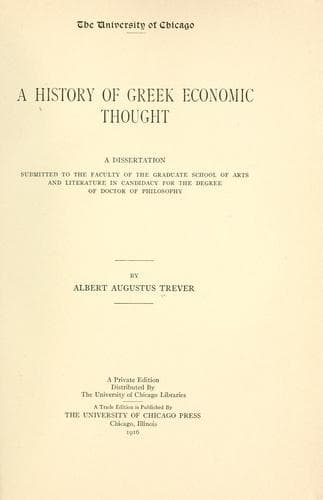
A History of Greek Economic ThoughtTrever, Albert Augustus
History
A History of Greek Economic Thought
Trever, Albert Augustus
Economics -- Greece -- History; Thesis (Ph. D.)
Aristotle argues further that equalization of property would be
powerless to prevent anything more than the merely petty crimes, for the
grossest ones are the result of inordinate desire, rather than of
inability to provide life’s necessities.[803] Moreover, there are many
other natural inequalities of life what would remain to arouse
discontent.[804] This is a sensible observation that has often been
overlooked by modern radical socialists, though its author might have
objected further that such personal diversities would also render an
abiding equality of property impossible. His previous argument, however,
that immorality and crimes are the result of inordinate desire, rather
than of economic need, might be answered today by the results of
investigations upon the relation of wages to morality.
The doctrine of communistic equality, as preached by some theorists in
fifth- and fourth-century Greece, and as satirized by Aristophanes,[805]
had no appeal for Aristotle. It was, to him, merely a thinly veiled
individualism. He saw through the selfish partisanship of both oligarchs
and democrats, and recognized that all men are poor judges in matters
that concern themselves.[806] The excessive individualism of the radical
democrat of his day, which permitted the majority to confiscate the
property of the minority in the name of a false equality, was as hateful
to him as it was to Plato.[807] As seen above, he insisted that economic
or political equality should not be demanded, except on the basis of
equality of service.[808] Exploitation by the radical democracy was, in
his eyes, as bad as the rule of a tyrant,[809] and the ruthless
individualism of the classes was no better.[810] Like Plato, he would
oppose to both of these the common interest, and would unite both masses
and classes in the aim to realize the highest moral life for the
individual through the state.[811] He refuted the Sophist’s theory of
social contract and of justice as a mere convention.[812] As Stewart has
observed he realized that “more powerful causes than the mere perception
of material advantage brought men into social union and keep them in
it.”[813] Each citizen, he held, is not his own master, but all belong
to the state. Each is a member (μόριον) of the social body, and the
concern of each is naturally relative to the good of the whole.[814]
Public-domain text, read in full here on John Shaqi.
Reviews
Reviews
No reviews yet
Be the first to share your thoughts on this work.
Elsewhere in the archive
Join the Discussion
Join the discussion
Sign in to leave a comment or review.
Sign InorCreate an account