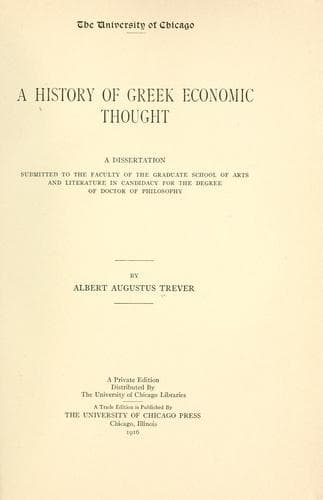
A History of Greek Economic ThoughtTrever, Albert Augustus
History
A History of Greek Economic Thought
Trever, Albert Augustus
Economics -- Greece -- History; Thesis (Ph. D.)
that he saw clearly the relation that exists in a democracy between the
economic condition of the masses and the stability of the state.[792] He
says that the genuine friend of the people (ἀληθινῶς δημοτικός) will see
that the masses are not very poor, for the best assurance of the abiding
welfare of the state is the solid prosperity of the great majority of
the population. He therefore advises the rich to contribute money for
furnishing plots of land or capital for small business enterprises to
the needy poor.[793] However, while the advice seems, on the surface, to
favor the commons, it is really a prudent suggestion to the upper
classes, appealing to their selfish interest to avoid by this method the
danger of a discontented proletariat.[794] Nevertheless, the general
economic attitude of Aristotle would warrant including him, with the
other Greek thinkers, in the statement of Roscher: “Die hellenische
Volkswirtschaftslehre hat niemals den grossen Fehler begangen, über dem
Reichtume die Menschen zu vergessen, und über der Vermehrung der
Menschenzahl, der Wohlstand der einzelnen gering zu achten.”[795]
Aristotle makes clear his attitude toward the institution of private
property and other related questions, both in his criticism of other
thinkers, and in his own positive suggestions for the ideal state.
Through his objections to the systems of Phaleas and Plato, he has
acquired the reputation of being the great defender of private property
in Greece. We shall see the extent to which this interpretation of him
is correct. Our consideration of his theory may be summarized under
certain topics which are fundamental to the problem of distribution.
He admits that the doctrine of economic equality may have some wisdom in
it.[796] The attempt to equalize possessions may tend slightly to
prevent civic discord.[797] Yet it is liable to arouse sedition on the
part of the exploited classes,[798] and such relief measures will
satisfy the masses only for a time, for they are notoriously
insatiate.[799] In his opinion, therefore, the saner remedy is
equalization of desires rather than of property,[800] which must be
realized by proper education and a right constitution, whereby the upper
classes shall not oppress, and the masses shall be held in check. We
have here still a valid argument against the more radical type of
socialism. It is suggestive of the modern doctrine of private property
as a public trust,[801] and presents clearly the antithesis between the
attitude of Greek thinkers and that of the modern social democracy.[802]
Public-domain text, read in full here on John Shaqi.
Reviews
Reviews
No reviews yet
Be the first to share your thoughts on this work.
Elsewhere in the archive
Join the Discussion
Join the discussion
Sign in to leave a comment or review.
Sign InorCreate an account