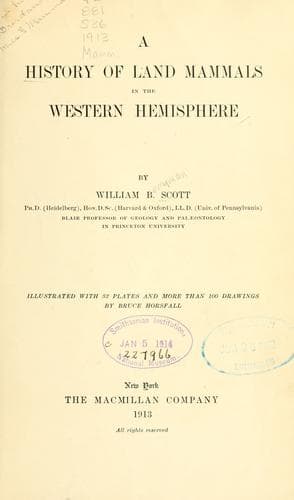
A history of land mammals in the western hemisphereScott, William Berryman
History
A history of land mammals in the western hemisphere
Scott, William Berryman
Mammals; Mammals, Fossil
In the case of lands newly raised above the sea and connecting formerly
separated areas, it is necessary that they should first be taken
possession of by vegetation, before they can become passable by animals,
for the migration of mammals from continent to continent is an entirely
distinct phenomenon from the annual migration of birds. The latter,
though a fact familiar to every one, is an unexplained mystery, and it is
somewhat unfortunate that the same term should be used for the completely
different process of the spread of mammals into newly opened land. This
spread is purely unconscious and is due to the pressure of increasing
numbers upon the means of subsistence, each new generation ranging
farther and farther from the original home of the species and continuing
so to extend until some insuperable obstacle is encountered. When a
sea-barrier is removed by upheaval and the newly formed land rendered
habitable for mammals through the invasion of plants, the interrupted
process is resumed and an interchange of species between the areas thus
connected is brought about. The interchange is, however, always an
incomplete one, certain forms not being able so to extend their range,
because of climatic differences, pre-occupation or some such barrier.
It is customary to give a graphic expression to the facts of animal
distribution by dividing the land surface of the earth into districts
which are characterized by their faunas. It is not possible to construct
a geographical scheme which will be equally satisfactory for all classes
of animals, because the geological date of most rapid development and
diffusion was so different in the various classes. The geographical and
climatic conditions which favoured a particular geographical arrangement
of one class had been so completely altered that the class coming in
later could not attain a similar distribution. For this reason, land
mammals are chosen as affording the best criteria; their adaptability is
such that they are found all over the earth, their dispersal is primarily
dependent upon the arrangement and connections of the continental
land-masses, modified by the topographical and climatic conditions, and
they, with the birds, are the latest of the vertebrate classes to assume
a dominating importance. Their history is the most fully known and falls
within the best understood portion of the earth’s history, making it
possible to follow their migrations with a precision which is seldom
feasible for the other classes of animals, and thus to correlate the
successive physical and organic changes. A particularly great advantage
which mammals possess for this purpose is that the mutual relationships
of the various kinds are better understood than in the case of most
other groups of animals. It is true that we shall find a great many
unsolved problems, upon which the most divergent opinions are held, but
the main outlines of the scheme are quite generally agreed upon.
Public-domain text, read in full here on John Shaqi.
Reviews
Reviews
No reviews yet
Be the first to share your thoughts on this work.
Elsewhere in the archive
Join the Discussion
Join the discussion
Sign in to leave a comment or review.
Sign InorCreate an account