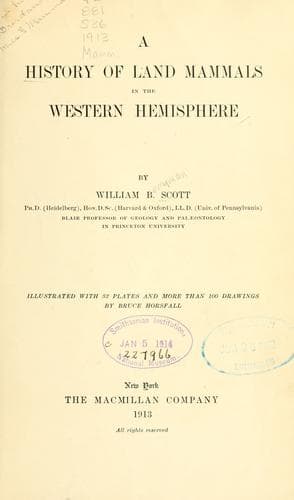
A history of land mammals in the western hemisphereScott, William Berryman
History
A history of land mammals in the western hemisphere
Scott, William Berryman
Mammals; Mammals, Fossil
Many plans for the zoölogical division of the continental areas have been
proposed by various writers on the subject, some differing very radically
from others. It would be useless and tedious to review even the more
important of the many proposals and suggestions which have been made in
the last half-century; and we may, with advantage, adopt an eclectic
scheme which has been slowly reached by successive approximations to a
satisfactory arrangement.
Just as in political geography it is found necessary to recognize
divisions of different rank and scope, like nation, state, county,
township, the facts of zoölogical geography require divisions of
different orders of importance. Thus, in descending order, the terms
_realm_, _region_, _subregion_, _province_, etc. are commonly employed,
but unfortunately they are often used loosely and even interchangeably;
yet it is desirable to attach a more or less precise significance to each
and more terms are needed for an accurate expression of the many complex
facts.
The extreme zoölogical peculiarity of Australia is recognized by making
that continent and its adjoining islands one of the great primary
divisions, of which the other includes all the rest of the world; the
former is characterized by its almost exclusively marsupial fauna, while
the other continents are inhabited by the Monodelphia or placental
mammals. Aside from Australia, by far the most isolated and peculiar
region of the earth is South America, and this fact is expressed by
constituting it into a _realm_, or division of the second order, and to
this realm is given the name _Neogæa_. The remaining continents, North
America, Europe, Asia and Africa, make up the other realm, _Arctogæa_,
in which there is an unmistakable general likeness among the mammals.
The three continents of the Old World form a vast, connected land-mass,
and the final separation of North America from this great complex is an
event of geologically recent date. For reasons that will be made clear
in the course of the history, the junction of the two Americas has had
comparatively little effect upon the zoölogy of the northern continent,
except in its tropical portion. It is obvious from a glance at the
map, that the great zoölogical divisions are of very unequal size, but
the arrangement is made on the basis of degrees of difference in the
mammalian faunas. These degrees of difference are, in turn, an expression
of length of separation or of the difficulty of communication between
connected lands.
The following table gives the major divisions of the earth apart from
Australia:
I. NEOGÆIC REALM. _Neotropical Region._—South and Central America,
lowlands of Mexico, the West Indies.
Public-domain text, read in full here on John Shaqi.
Reviews
Reviews
No reviews yet
Be the first to share your thoughts on this work.
Elsewhere in the archive
Join the Discussion
Join the discussion
Sign in to leave a comment or review.
Sign InorCreate an account