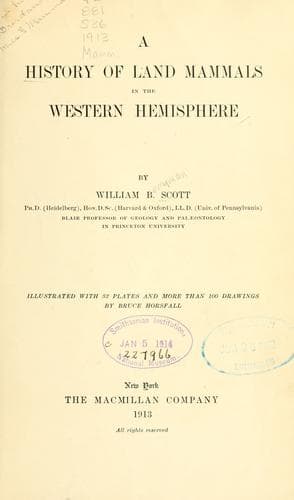
A history of land mammals in the western hemisphereScott, William Berryman
History
A history of land mammals in the western hemisphere
Scott, William Berryman
Mammals; Mammals, Fossil
Preying upon this great assemblage of hoofed animals was a corresponding
array of Carnivora, most of which were indigenous and derived from
American stocks, but there was a considerable migrant element also,
such as the bears and badgers. Nearly all the modern kinds of
flesh-eaters found in the North America of to-day were already here
in the Pleistocene, minks, weasels, martens, skunks, otters, badgers,
wolverenes, raccoons, foxes, wolves, coyotes, pumas, etc., etc., but
there were several others which are either now extinct or no longer
to be found in this continent. Of the extinct types much the most
striking were the several species of †sabre-tooth tigers (_†Smilodon_,
see Frontispiece) which have been found in the greater part of the
United States and no doubt ranged over the whole. These were massive,
short-tailed and rather short-legged, but very muscular and powerful,
cat-like animals, in which the upper canine teeth were converted into
great, recurved, scimitar-like tusks. These large beasts of prey, which
about equalled the Leopard in height, but were far heavier, belonged
to a group which, at one time or another, spread over nearly the whole
world and persisted much later and attained a larger size and higher
development in the western hemisphere than in the eastern. They had a
very long American ancestry, from the lower Oligocene to the end of
the Pleistocene, but the place of their origin is still unknown. In
addition to the pumas and lynxes, there were some very large true felines
(_Felis †atrox_ and _F. †imperialis_), which closely resembled the Lion
(_F. leo_) in size, appearance and structure, and have been found in
California and the Mississippi Valley; probably these great cats were
immigrants, but they may represent a native development of Miocene and
Pliocene stock; the history of the family is too imperfect for a decision
of this question.
Besides coyotes and wolves which are indistinguishable from existing
species, there were some very large wolves, now extinct, of which the
commonest and most widely distributed was _Canis †dirus_ (also called _C.
†indianensis_) so abundant in the asphalts of southern California. Bears
were not so common in the middle Pleistocene and have not been found in
the older part of that epoch, though they probably had already reached
North America from the Old World, where they originated. Their absence
from the older Pleistocene (Equus Beds) may be accounted for by the fact
that those beds contain a fauna of the open plains, while bears are
chiefly forest-living animals. An extinct type of the family is the group
of species which constitute the †short-faced bears (_†Arctotherium_),
very large and powerful creatures, with remarkably shortened jaws, which
have been found from ocean to ocean. The smaller beasts of prey, badgers,
weasels, etc., were, as intimated above, substantially the same as now.
Public-domain text, read in full here on John Shaqi.
Reviews
Reviews
No reviews yet
Be the first to share your thoughts on this work.
Elsewhere in the archive
Join the Discussion
Join the discussion
Sign in to leave a comment or review.
Sign InorCreate an account