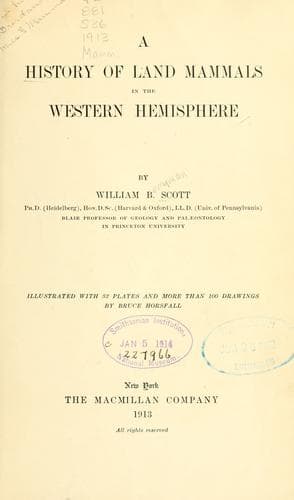
A history of land mammals in the western hemisphere — John Shaqi
A history of land mammals in the western hemisphereScott, William Berryman
History
A history of land mammals in the western hemisphere
Scott, William Berryman
Mammals; Mammals, Fossil
Great and well founded as is our confidence in fossils as fixing the
geological date of the rocks in which they occur, it must not be
forgotten that the succession of the different kinds of fossils in
time was first determined from the superposition of the containing
strata. Hence, it is always a welcome confirmation of the chronological
inferences drawn from the study of fossils, when those inferences can
be unequivocally established by the succession of the beds themselves.
For example, in the Tertiary deposits of the West are two formations or
groups of strata, called respectively the Uinta and the White River,
which had never been known to occur in the same region and whose relative
age therefore could not be determined by the method of superposition.
Each of the formations, however, has yielded a large number of
well-preserved fossil mammals, and the comparative study of these mammals
made it clear that the Uinta must be older than the White River and that
no very great lapse of time, geologically speaking, occurred between the
end of the former and the beginning of the latter. Only two or three
years ago an expedition from the American Museum of Natural History
discovered a place in Wyoming where the White River beds lie directly
upon those of the Uinta, thus fully confirming the inference as to the
relative age of these two formations which had long ago been drawn from
the comparative study of their fossil mammals.
The palæontological method of determining the geological date of the
stratified rocks is thus an indispensable means of correlating the
scattered exposures of the strata in widely separated regions and in
different continents, it may be with thousands of miles of intervening
ocean. The general principle employed is that _close similarity of
fossils in the rocks of the regions compared points to an approximately
contemporaneous date of formation of those rocks_. This principle must
not, however, be applied in an off-hand or uncritical manner, or it will
lead to serious error. In the first place, the evolutionary process is a
very slow one and geological time is inconceivably long, so that deposits
which differ by some thousands of years may yet have the same or nearly
the same fossils. The method is not one of sufficient refinement to
detect such relatively small differences. To recur to the illustration
of the development in handwriting, the palæographer can hardly do more
than determine the decade in which a manuscript was written; no one would
expect him to fix upon the exact year, still less the month, from the
study of handwriting alone. As is the month in recorded human history, so
is the millennium in the long course of the earth’s development.
Public-domain text, read in full here on John Shaqi.
Reviews
Reviews
No reviews yet
Be the first to share your thoughts on this work.
Join the Discussion
Join the discussion
Sign in to leave a comment or review.
Sign InorCreate an account