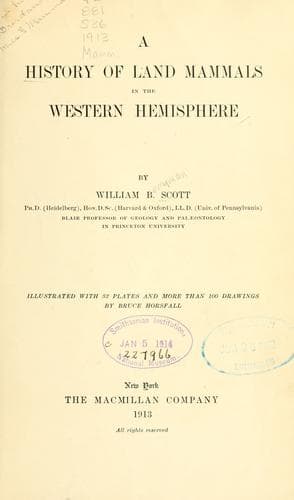
A history of land mammals in the western hemisphereScott, William Berryman
History
A history of land mammals in the western hemisphere
Scott, William Berryman
Mammals; Mammals, Fossil
The middle Eocene fauna, Bridger stage, though it passed upward very
gradually into that of the Uinta, was yet, on the whole, very different
from the latter. It was exclusively indigenous and so radically distinct
from the mammals of corresponding date in Europe as to preclude the
possibility of a land-bridge with that continent. In the lower Eocene,
as will be shown in a subsequent page, the communication between the two
continents was broadly open and the faunas of the two continents were
much more closely similar than they have ever been since. It is really
remarkable to see with what comparative rapidity the two regions, when
severed, developed different mammals under the operation of divergent
evolution. Had the separation continued throughout the Tertiary and
Quaternary periods, North America would now have been as peculiar
zoölogically as South America is, a result which has been prevented by
the repeated renewal of the connection.
The characteristic features of the Bridger mammalian fauna were chiefly
due to the great expansion and diversification of certain families,
which began their career at an earlier stage, and to the disappearance
of many archaic groups which had marked the more ancient faunas. Other
archaic groups, however, survived and even flourished in the Bridger,
and of these it is particularly difficult to convey a correct notion
to the reader, because they were so utterly unlike anything that now
lives. One of these orders, the †Tæniodontia, which had so many points
of resemblance to the †ground-sloths that several writers have not
hesitated to include them in the Edentata, survived only into the older
Bridger, but the equally problematical †Tillodontia then reached their
culmination, though they were not very numerous. Though not at all
related to that group, the †tillodonts looked like huge rodents, with
their chisel-like incisor teeth. There was a remarkable assemblage of
Insectivora, more numerous and varied than in any subsequent formation,
no less than six families being known. One of these somewhat doubtfully
represented the moles and two others modern Asiatic groups. The very
unexpected discovery of an armadillo in the Bridger has been reported,
but the propriety of referring this animal to the armadillos, or even
to the edentates, has not yet been proved, and it would therefore be
premature to discuss its significance. The only marsupials were opossums.
Public-domain text, read in full here on John Shaqi.
Reviews
Reviews
No reviews yet
Be the first to share your thoughts on this work.
Elsewhere in the archive
Join the Discussion
Join the discussion
Sign in to leave a comment or review.
Sign InorCreate an account