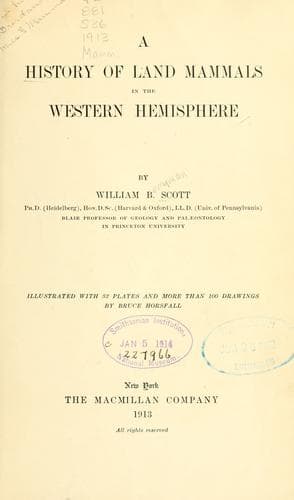
A history of land mammals in the western hemisphereScott, William Berryman
History
A history of land mammals in the western hemisphere
Scott, William Berryman
Mammals; Mammals, Fossil
One afternoon in June, 1876, three Princeton undergraduates were lying
under the trees on the canal bank, making a languid pretence of preparing
for an examination. Suddenly, one of the trio remarked: “I have been
reading an old magazine article which describes a fossil-collecting
expedition in the West; why can’t we get up something of the kind?” The
others replied, as with one voice, “We can; let’s do it.” This seemingly
idle talk was, for Osborn and myself, a momentous one, for it completely
changed the careers which, as we then believed, had been mapped out for
us. The random suggestion led directly to the first of the Princeton
palæontological expeditions, that of 1877, which took us to the “Bad
Lands” of the Bridger region in southwestern Wyoming. The fascination of
discovering and exhuming with our own hands the remains of the curious
creatures which once inhabited North America, but became extinct ages
ago, has proved an enduring delight. It was the wish to extend something
of this fascinating interest to a wider circle, that occasioned the
preparation of this book.
The western portion of North America has preserved a marvellous series
of records of the successive assemblages of animals which once dwelt
in this continent, and in southernmost South America an almost equally
complete record was made of the strange animals of that region. For
the last half-century, or more, many workers have coöperated to bring
this long-vanished world to light and to decipher and interpret the
wonderful story of mammalian development in the western hemisphere. The
task of making this history intelligible, not to say interesting, to the
layman, has been one of formidable difficulty, for it is recorded in
the successive modifications of the bones and teeth, and without some
knowledge of osteology, these records are in an unknown tongue. To meet
this need, Chapter III gives a sketch of the mammalian skeleton and
dentition, which the reader may use as the schoolboy uses a vocabulary
to translate his Latin exercise, referring to it from time to time, as
may be necessary to make clear the descriptions of the various mammalian
groups. Technical terms have been avoided as far as possible, but,
unfortunately, it is not practicable to dispense with them altogether.
The appended glossary will, it is hoped, minimize the inconvenience.
Public-domain text, read in full here on John Shaqi.
Reviews
Reviews
No reviews yet
Be the first to share your thoughts on this work.
Join the Discussion
Join the discussion
Sign in to leave a comment or review.
Sign InorCreate an account