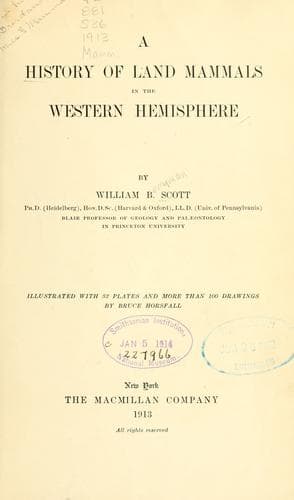
A history of land mammals in the western hemisphereScott, William Berryman
History
A history of land mammals in the western hemisphere
Scott, William Berryman
Mammals; Mammals, Fossil
The evidence of climatic changes is of two principal kinds, (1) that
derived from a study of the rocks themselves, and (2) that given by the
fossils of the various epochs. So far as the rocks laid down in the sea
are concerned, little has yet been ascertained regarding the climatic
conditions of their formation, but the strata which were deposited on
the land, or in some body of water other than the sea, often give the
most positive and significant information concerning the circumstances of
climate which prevailed at the time of their formation. Certain deposits,
such as gypsum and rock-salt, are accumulated only in salt lakes, which,
in turn, are demonstrative proof of an arid climate. A salt lake could
not exist in a region of normal rainfall and, from the geographical
distribution of such salt-lake deposits, it may be shown that arid
conditions have prevailed in each of the continents and, not only once,
but many times. As a rule, such aridity of climate was relatively local
in extent, but sometimes it covered vast areas. For example, in the
Permian, the last of the Palæozoic, and the Triassic, the first of the
Mesozoic periods (see Table, p. 15) nearly all the land-areas of the
northern hemisphere were affected, either simultaneously or in rapid
succession.
Until a comparatively short time ago, it was very generally believed that
the Glacial or Pleistocene epoch, which was so remarkable and conspicuous
a feature of the Quaternary period, was an isolated phenomenon, unique in
the entire history of the earth. Now, however, it has been conclusively
shown that such epochs of cold have been recurrent and that no less than
five of these have left unmistakable records in as many widely separated
periods of time.
When the hypothesis of a great “Ice Age” in the Pleistocene was first
propounded by the elder Agassiz, it was naturally received with general
incredulity, but the gradual accumulation of proofs has resulted in
such an overwhelming weight of testimony, that the glacial hypothesis
is now accepted as one of the commonplaces of Geology. The proofs
consist chiefly in the characteristic glacial accumulations, moraines
and drift-sheets, which cover such enormous areas in Europe and North
America and, on a much smaller scale, in Patagonia, and in the equally
characteristic marks of glacial wear left upon the rocks over which
the ice-sheets moved. Many years later it was proved that the Permian
period had been a time of gigantic glaciation, chiefly in the southern
hemisphere, when vast ice-caps moved slowly over parts of South America,
South Africa, Australia and even of India. The evidence is of precisely
the same nature as in the case of the Pleistocene glaciation. In not less
than three more ancient periods, the Devonian, Cambrian, and Algonkian,
proofs of glacial action have been obtained.
Public-domain text, read in full here on John Shaqi.
Reviews
Reviews
No reviews yet
Be the first to share your thoughts on this work.
Join the Discussion
Join the discussion
Sign in to leave a comment or review.
Sign InorCreate an account