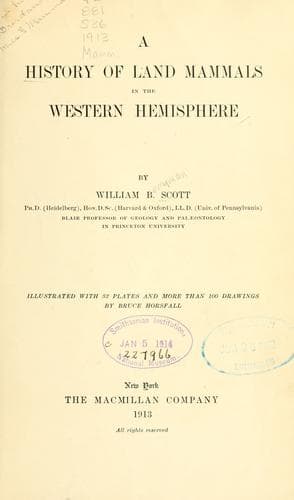
A history of land mammals in the western hemisphereScott, William Berryman
History
A history of land mammals in the western hemisphere
Scott, William Berryman
Mammals; Mammals, Fossil
In the arid and desolate regions of the interior of South Australia is a
series of immense dry lakes, which only occasionally contain water and
ordinarily “are shallow, mud-bottomed or salt-encrusted claypans only.”
One of these, Lake Callabonna, is of great interest as having preserved
in its soft mud many remains of ancient life, of creatures which were
mired in the clay and destroyed, as has been described by Dr. E. C.
Stirling. “There is, however, compensation for the unpromising physical
features of Lake Callabonna in the fact that its bed proves to be a
veritable necropolis of gigantic extinct marsupials and birds which
have apparently died where they lie, literally, in hundreds. The facts
that the bones of individuals are often unbroken, close together, and,
frequently, in their proper relative positions, the attitude of many of
the bodies and the character of the matrix in which they are embedded,
negative any theory that they have been carried thither by floods. The
probability is, rather, that they met their deaths by being entombed
in the effort to reach food or water, just as even now happens in dry
seasons, to hundreds of cattle which, exhausted by thirst and starvation,
are unable to extricate themselves from the boggy places that they have
entered in pursuit either of water or of the little green herbage due to
its presence. The accumulation of so many bodies in one locality points
to the fact of their assemblage around one of the last remaining oases
in the region of desiccation which succeeded an antecedent condition of
plenteous rains and abundant waters.”
Public-domain text, read in full here on John Shaqi.
Reviews
Reviews
No reviews yet
Be the first to share your thoughts on this work.
Join the Discussion
Join the discussion
Sign in to leave a comment or review.
Sign InorCreate an account