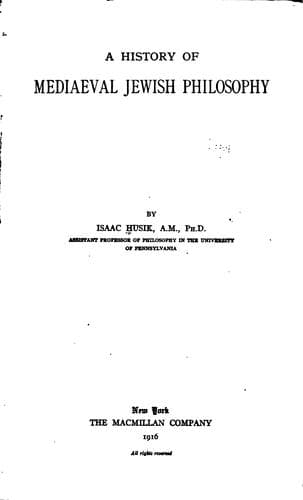
A History of Mediaeval Jewish PhilosophyHusik, Isaac
ReligionJewish
A History of Mediaeval Jewish Philosophy
Husik, Isaac
Philosophy, Jewish; Philosophy, Medieval
spirit of piety and warmth of heart--an attitude reflected in his style,
which helped to make his work the most popular moral-religious book in
Jewish literature--there is no trace of pantheism or metaphysical
mysticism in his nature. His ideas are sane and rational, and their
expression clear and transparent. Gabirol's high flights in the "Fons
Vitæ" have little in common with Bahya's modest and brief outline of the
familiar doctrines of the existence, unity and attributes of God, for
which he claims no originality, and which serve merely as the background
for his contribution to religious ethics. That Bahya should have taken a
few leading notions from the "Fons Vitæ," such as did not antagonize his
temperament and mode of thinking, is quite possible, and we shall best
explain such resemblances in this manner.
As Abraham ibn Ezra in 1156 makes mention of Bahya and his views,[108]
we are safe in concluding that the "Duties of the Hearts" was written
between 1100 and 1156.
As the title of the work indicates, Bahya saw the great significance of
a distinction made by Mohammedan theologians and familiar in their
ascetic literature, between outward ceremonial or observance, known as
"visible wisdom" and "duties of the limbs," and inward intention,
attitude and feeling, called "hidden wisdom" and "duties of the
hearts."[109] The prophet Isaiah complains that the people are diligent
in bringing sacrifices, celebrating the festivals and offering prayer
while their hands are full of blood. He informs them that such conduct
is an abomination to the Lord, and admonishes them to wash themselves,
to make themselves clean, to put away the evil of their deeds from
before God's eyes; to cease to do evil; to learn to do well, to seek for
justice, to relieve the oppressed, to do justice to the fatherless, to
plead for the widow (Isa. 1, 11-17). This is a distinction between
duties to God and duties to one's fellow man, between religious ceremony
and ethical practice. Saadia makes a further distinction--also found in
Arabic theology before him--between those commandments and prohibitions
in the Bible which the reason itself approves as right or condemns as
wrong--the rational commandments--and those which to the reason seem
indifferent, and which revelation alone characterizes as obligatory,
permitted or forbidden--the so-called "traditional commandments."
Public-domain text, read in full here on John Shaqi.
Reviews
Reviews
No reviews yet
Be the first to share your thoughts on this work.
Elsewhere in the archive
Join the Discussion
Join the discussion
Sign in to leave a comment or review.
Sign InorCreate an account