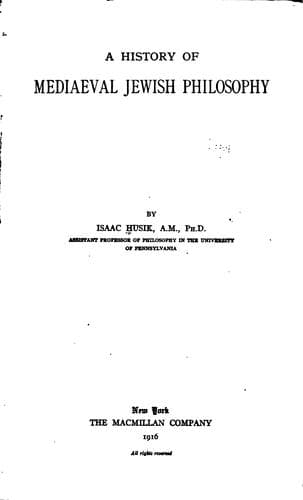
A History of Mediaeval Jewish PhilosophyHusik, Isaac
ReligionJewish
A History of Mediaeval Jewish Philosophy
Husik, Isaac
Philosophy, Jewish; Philosophy, Medieval
Bahya's division is identical with neither the one nor the other.
Ethical practice may be purely external and a matter of the limbs, quite
as much as sacrifice and ceremonial ritual. On the other hand, one may
feel profoundly moved with the spirit of true piety, love of God and
loyalty to his commandments in the performance of a so-called
"traditional commandment," like the fastening of a "mezuzah" to the
door-post. Bahya finds room for Saadia's classification but it is with
him of subordinate importance, and is applicable only to the "duties of
the limbs." Among these alone are there some which the reason unaided by
revelation would not have prescribed. The "duties of the heart" are all
rational. Like all precepts they are both positive and negative.
Examples of positive duties of the heart are, belief in a creator who
made the world out of nothing; belief in his unity and incomparability;
the duty to serve him with all our heart, to trust in him, to submit to
him, to fear him, to feel that he is watching our open and secret
actions, to long for his favor and direct our actions for his name's
sake; to love those who love him so as to be near unto him, and to hate
those who hate him. Negative precepts of this class are the opposites of
those mentioned, and others besides, such as that we should not covet,
or bear a grudge, or think of forbidden things, or desire them or
consent to do them. The common characteristic of all duties of the heart
is that they are not visible to others. God alone can judge whether a
person's feeling and motives are pure or the reverse.
That these duties are incumbent upon us is clear from every point of
view. Like Saadia Bahya finds the sources of knowledge, particularly of
the knowledge of God's law and religion, in sense, reason, written law
and tradition. Leaving out the senses which are not competent in this
particular case, the obligatory character of the duties of the heart is
vouched for by the other three, reason, law, tradition.
From reason we know that man is composed of soul and body, and that both
are due to God's goodness. One is visible, the other is not. Hence we
are obliged to worship God in a two-fold manner; with visible worship
and invisible. Visible worship represents the duties of the limbs, such
as prayer, fasting, charity, and so on, which are carried out by the
visible organs. The hidden worship includes the duties of the heart, for
example, to think of God's unity, to believe in him and his Law, to
accept his worship, etc., all of which are accomplished by the thought
of the mind, without the assistance of the visible limbs.
Besides, the duties of the limbs, the obligation of which no one doubts,
are incomplete without the will of the heart to do them. Hence it
follows that there is a duty upon our souls to worship God to the extent
of our powers.
Public-domain text, read in full here on John Shaqi.
Reviews
Reviews
No reviews yet
Be the first to share your thoughts on this work.
Elsewhere in the archive
Join the Discussion
Join the discussion
Sign in to leave a comment or review.
Sign InorCreate an account