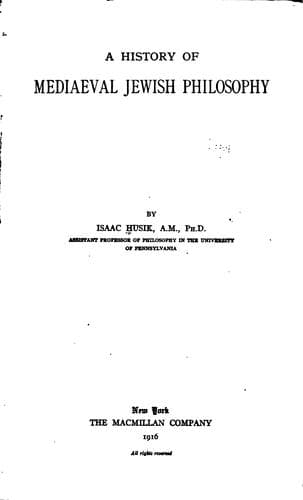
A History of Mediaeval Jewish PhilosophyHusik, Isaac
ReligionJewish
A History of Mediaeval Jewish Philosophy
Husik, Isaac
Philosophy, Jewish; Philosophy, Medieval
Among the Arabs the earliest division based upon a theoretical question
was that of the parties known as the "Kadariya" and the "Jabariya."[10]
The problem which was the cause of the difference was that of free will
and determinism. Orthodox Islam favored the idea that man is completely
dependent upon the divine will, and that not only his destiny but also
his conduct is determined, and his own will does not count. This was the
popular feeling, though as far as the Koran is concerned the question
cannot be decided one way or the other, as it is not consistent in its
stand, and arguments can be drawn in plenty in favor of either opinion.
The idea of determinism, however, seemed repugnant to many minds, who
could not reconcile this with their idea of reward and punishment and
the justice of God. How is it possible that a righteous God would force
a man to act in a certain manner and then punish him for it? Hence the
sect of the "Kadariya," who were in favor of freedom of the will. The
Jabariya were the determinists.
This division goes back to a very early period before the introduction
of the Aristotelian philosophy among the Arabs, and hence owes its
inception not to reason as opposed to religious dogma, but to a pious
endeavor to understand clearly the religious view upon so important a
question.
From the Kadariya, and in opposition to the Aristotelian movement which
had in the meantime gained ground, developed the school of theologians
known as the "Mutakallimun." They were the first among the Arabs who
deliberately laid down the reason as a source of knowledge in addition
to the authority of the Koran and the "Sunna" or tradition. They were
not freethinkers, and their object was not to oppose orthodoxy as such.
On the contrary, their purpose was to purify the faith by freeing it
from such elements as obscured in their minds the purity of the
monotheistic tenet and the justice of God. They started where the
Kadariya left off and went further. As a school of opposition their
efforts were directed to prove the creation of the world, individual
providence, the reality of miracles, as against the "philosophers," _i.
e._, the Aristotelians, who held to the eternity of motion, denied God's
knowledge of particulars, and insisted on the unchanging character of
natural law.
Public-domain text, read in full here on John Shaqi.
Reviews
Reviews
No reviews yet
Be the first to share your thoughts on this work.
Join the Discussion
Join the discussion
Sign in to leave a comment or review.
Sign InorCreate an account