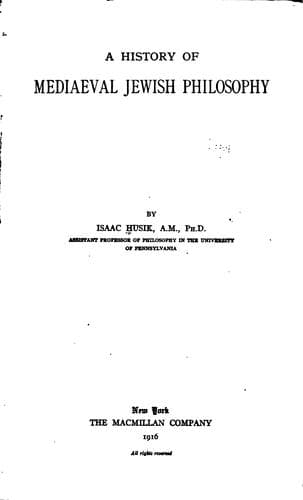
A History of Mediaeval Jewish PhilosophyHusik, Isaac
ReligionJewish
A History of Mediaeval Jewish Philosophy
Husik, Isaac
Philosophy, Jewish; Philosophy, Medieval
Another reason for the importance of the Muʿtazilite school for the
history of Jewish thought is of recent discovery. Schreiner has
suggested[12] that the origin of the Muʿtazilite movement was due to the
influence of learned Jews with whom the Mohammedans came in contact,
particularly in the city of Basra, an important centre of the school.
The reader will recall that the two main doctrines of the Muʿtazila were
the unity of God and his justice. The latter really signified the
freedom of the will. That these are good Jewish views would of course
prove nothing for the origin of similar opinions among the Mohammedans.
For it is not here a question simply of the dogmatic belief in
Monotheism as opposed to polytheism. Mohammedanism is as a religion
Monotheistic and we know that Mohammed was indebted very much to Jews
and Judaism. We are here concerned with the origin of a rationalistic
movement which endeavors to defend a spiritual conception of God against
a crude anthropomorphism, to vindicate a conception of his absolute
unity against the threatened multiplication of his essence by the
assumption of eternal attributes, and which puts stress upon God's
justice rather than upon his omnipotence so as to save human freedom.
Another doctrine of the Muʿtazila was that the Koran was not eternal as
the orthodox believed, but that it was created. Now we can find
parallels for most of these doctrines. Anthropomorphism was avoided in
the Aramaic translations of the Pentateuch, also in certain changes in
the Hebrew text which are recorded in Rabbinical literature, and known
as "Tikkune Soferim," or corrections of the Scribes.[13] Concern for
maintaining the unity of God in its absolute purity is seen in the care
with which the men of the Agada forbid any prayer which may have a
semblance, however remote, of dualism.[14] The freedom of the will is
clearly stated in the Rabbinic expression, "All is in the hands of God
except the fear of Heaven."[15] And an apparently deterministic passage
in Job 23, 13, "But he is one and who can turn him, and what his soul
desireth, even that he doeth," is explained by Rabbi Akiba in the
following manner, "It is not possible to answer the words of him who
with his word created the world, for he rules all things with truth and
with righteousness."[16] And we find a parallel also for the creation of
the Koran in the Midrashic statement that the Torah is one of the six or
seven things created before the world.[17]
Public-domain text, read in full here on John Shaqi.
Reviews
Reviews
No reviews yet
Be the first to share your thoughts on this work.
Join the Discussion
Join the discussion
Sign in to leave a comment or review.
Sign InorCreate an account