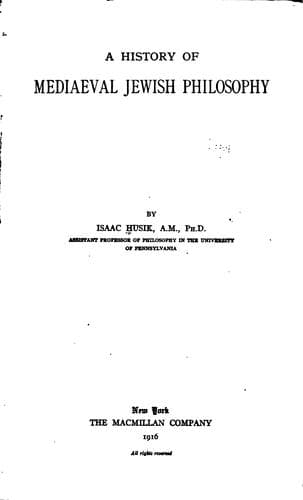
A History of Mediaeval Jewish PhilosophyHusik, Isaac
ReligionJewish
A History of Mediaeval Jewish Philosophy
Husik, Isaac
Philosophy, Jewish; Philosophy, Medieval
The king then said, I will ask the Christians and the Mohammedans. I
need not inquire of the Jews, for their low condition is sufficient
proof that the truth cannot be with them. So he sent for a Christian
sage, who explained to him the essentials of his belief, saying among
other things, We believe in the creation of the world in six days, in
the descent of all men from Adam, in revelation and Providence, in
short, in all that is found in the law of Moses and in the other
Israelitish Scriptures, which cannot be doubted because of the publicity
which was given to the events recorded therein. He also quoted the
words of the gospel, I did not come to destroy any of the commandments
of Israel and of Moses their teacher; I came to confirm them.
The king was not convinced by the Christian belief, and called a
Mohammedan doctor, who in describing the specific tenets of
Mohammedanism also mentioned the fact that in the Koran are quoted the
Pentateuch and Moses and the other leaders, and the wonderful things
they did. These, he said, cannot be denied; for they are well known.
Seeing that both Christian and Mohammedan referred to the law of Moses
as true, and as evidence that God spoke to man, the king determined to
call a Jewish sage also, and hear what he had to say.
The Jewish "Haber," as Judah Halevi calls him, began his discourse by
saying, We Jews believe in the God of Abraham, Isaac and Jacob, who took
the children of Israel out of Egypt, supported them in the wilderness,
gave them the land of Canaan, and so on.
The king was disappointed and said, I had determined not to consult the
Jews in this matter at all, because their abject condition in the world
did not leave them any good quality. You should have said, he told the
Jew, that you believe in him who created the world and governs it; who
made man and provides for him. Every religionist defends his belief in
this way.
Public-domain text, read in full here on John Shaqi.
Reviews
Reviews
No reviews yet
Be the first to share your thoughts on this work.
Elsewhere in the archive
Join the Discussion
Join the discussion
Sign in to leave a comment or review.
Sign InorCreate an account