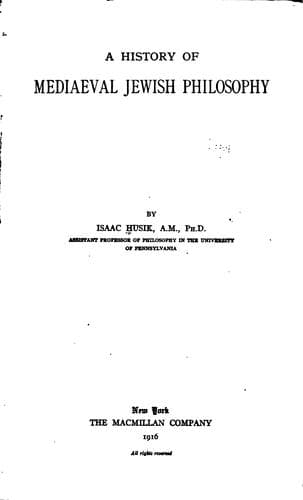
A History of Mediaeval Jewish PhilosophyHusik, Isaac
ReligionJewish
A History of Mediaeval Jewish Philosophy
Husik, Isaac
Philosophy, Jewish; Philosophy, Medieval
The Jew replied, The religion to which you refer is a rational religion,
established by speculation and argument, which are full of doubt, and
about which there is no agreement among philosophers, because not all
the arguments are valid or even plausible. This pleased the king, and he
expressed a wish to continue the discourse. The Rabbi then said, The
proper way to define one's religion is by reference to that which is
more certain, namely, actual experience. Jews have this actual
experience. The God of Abraham, Isaac and Jacob spoke to Moses and
delivered the Israelites out of Egypt. This is well known. God gave
Israel the Torah. To be sure, all others not of Israel who accept the
Law will be rewarded, but they cannot be equal to Israel. There is a
peculiar relation between God and Israel in which the other peoples do
not share. As the plant is distinguished from the mineral, the animal
from the plant, and man from the irrational animal, so is the prophetic
individual distinguished above other men. He constitutes a higher
species. It is through him that the masses became aware of God's
existence and care for them. It was he who told them things unknown to
them; who gave them an account of the world's creation and its history.
We count now forty-five hundred years from the creation. This was handed
down from Adam through Seth and Enos to Noah, to Shem and Eber, to
Abraham, Isaac and Jacob, to Moses, and finally to us. Moses came only
four hundred years after Abraham in a world which was full of knowledge
of heavenly and earthly things. It is impossible that he should have
given them a false account of the division of languages and the
relations of nations without being found out and exposed.
The philosophers, it is true, oppose us by maintaining that the world is
eternal. But the philosophers are Greeks, descended from Japheth, who
did not inherit either wisdom or Torah. Divine wisdom is found only in
the family of Shem. The Greeks had philosophy among them only during the
short time of their power. They borrowed it from the Persians, who had
it in turn from the Chaldeans. But neither before nor after did they
have any philosophers among them.
Public-domain text, read in full here on John Shaqi.
Reviews
Reviews
No reviews yet
Be the first to share your thoughts on this work.
Elsewhere in the archive
Join the Discussion
Join the discussion
Sign in to leave a comment or review.
Sign InorCreate an account