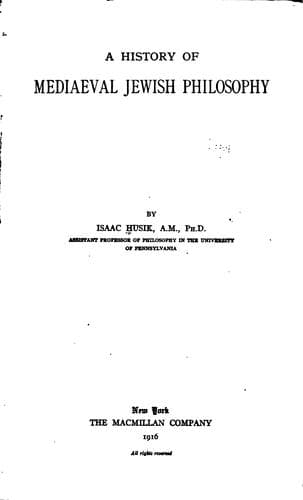
A History of Mediaeval Jewish PhilosophyHusik, Isaac
ReligionJewish
A History of Mediaeval Jewish Philosophy
Husik, Isaac
Philosophy, Jewish; Philosophy, Medieval
The right practice of the pious man at the present day is to give all
the parts of the body their due and no more, without neglecting any of
them; and to bring the lower powers and desires under the dominion of
the higher; feeding the soul with things spiritual as the body with
things material. He must keep himself constantly under guard and
control, making special use of the times of prayer for self-examination,
and striving to retain the influence of one prayer until the time comes
for the next. He must also utilize the Sabbaths and the festivals and
the Great Fast to keep himself in good spiritual trim. In addition he
must observe all the commandments, traditional, rational, and those of
the heart, and reflect on their meaning and on God's goodness and
care.[198]
Judah Halevi has no doubt of the immortality of the soul and of reward
and punishment after death, though the Bible does not dwell upon these
matters with any degree of emphasis. Other religions, he admits, make
greater promises of reward after death, whereas Judaism offers divine
nearness through miracles and prophecy. Instead of saying, If you do
thus and so, I will put you in gardens after death and give you
pleasures, our Law says, I will be your God and you will be my people.
Some of you will stand before me and will go up to heaven, walking among
the angels; and my angels will walk among you, protecting you in your
land, which is the holy land, not like the other nations, which are
governed by nature. Surely, he exclaims, we who can boast of such things
during life are more certain of the future world than those whose sole
reliance is on promises of the hereafter. It would not be correct, the
Rabbi says to the king of the Chazars, who was tempted to despise the
Jews as well as their religion because of their material and political
weakness, to judge of our destiny after death by our condition during
life, in which we are inferior to all other people. For these very
people, like the Christians and Mohammedans, glory in their founders,
who were persecuted and despised, and not in the present power and
luxury of the great kings. The Christians in particular worship the man
who said, "Whosoever smiteth thee on thy right cheek, turn to him the
other also. And if a man ... take away thy coat, let him have thy cloak
also" (Matth. 5, 39). Accordingly our worth is greater in the sight of
God than if we were prosperous. It is true that not all of us accept our
miserable condition with becoming humility. If we did, God would not
keep us so long in misery. But after all there is reward awaiting our
people for bearing the yoke of the exile voluntarily, when it would be
an easy matter for any one of us to become a brother to our oppressors
by the saying of one word.
Public-domain text, read in full here on John Shaqi.
Reviews
Reviews
No reviews yet
Be the first to share your thoughts on this work.
Elsewhere in the archive
Join the Discussion
Join the discussion
Sign in to leave a comment or review.
Sign InorCreate an account