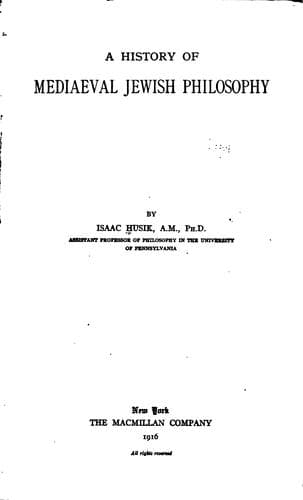
A History of Mediaeval Jewish PhilosophyHusik, Isaac
ReligionJewish
A History of Mediaeval Jewish Philosophy
Husik, Isaac
Philosophy, Jewish; Philosophy, Medieval
Our wise men, too, have said a great deal about the pleasures and
sufferings awaiting us in the next world, and in this also they surpass
the wise men of other religions. The Bible, it is true, does not lay
stress on this aspect of our belief; but so much is clear from the Bible
also, that the spirit returns to God. There are also allusions to the
immortality of the soul in the disappearance of Elijah, who did not die,
and in the belief of his second coming. This appears also from the
prayer of Balaam, "Let me die the death of the righteous, and may my
last end be like his" (Num. 23, 10), and from the calling of Samuel from
the dead. The idea of paradise (Gan Eden) is taken from the Torah, and
Gehenna is a Hebrew word, the name of a valley near Jerusalem, where
fire always burned, consuming unclean bones, carcases, and so on. There
is nothing new in the later religions which is not already found in
ours.[199]
An important ethical problem which Judah Halevi discusses more
thoroughly than any of his predecessors is that of free will, which he
defends against fatalistic determinism, and endeavors to reconcile with
divine causality and foreknowledge. We have already seen (p. xxi) that
this was one of the important theses of the Muʿtazilite Kalam. And there
is no doubt that fatalism is opposed to Judaism. A fatalistic
determinist denies the category of the contingent or possible. He says
not merely that an event is determined by its proximate cause, he goes
further and maintains that it is determined long in advance of any of
its secondary causes by the will of God. It would follow then that there
is no way of preventing an event thus predetermined. If we take pains to
avoid a misfortune fated to come upon us, our very efforts may carry us
toward it and land us in its clutches. Literature is full of stories
illustrating this belief, as for example the story of Œdipus. Against
this form of belief Judah Halevi vindicates the reality of the
contingent or possible as opposed to the necessary. No one except the
obstinate and perverse denies the possible or contingent. His
preparations to meet and avoid that which he hopes and fears prove that
he believes the thing amenable to pains and precautions. If he had not
this belief, he would fold his hands in resignation, never taking the
trouble to supply himself with arms to meet his enemy, or with water to
quench his thirst. To be sure, we may argue that whether one prepare
himself or omit to do so, the preparation or neglect is itself
determined. But this is no longer the same position as that maintained
at the outset. For we now admit that secondary causes do play a part in
determining the result, whereas we denied it at first. The will is one
of these secondary causes. Accordingly Judah Halevi divides all acts or
events into four classes, divine, natural, accidental and voluntary.
Strictly divine events are the direct results of the divine will without
any intermediate cause.
Public-domain text, read in full here on John Shaqi.
Reviews
Reviews
No reviews yet
Be the first to share your thoughts on this work.
Elsewhere in the archive
Join the Discussion
Join the discussion
Sign in to leave a comment or review.
Sign InorCreate an account