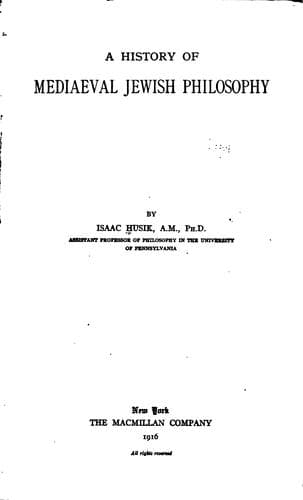
A History of Mediaeval Jewish PhilosophyHusik, Isaac
ReligionJewish
A History of Mediaeval Jewish Philosophy
Husik, Isaac
Philosophy, Jewish; Philosophy, Medieval
There is no way of preparing for or avoiding
these; not, that is, physically; but it is possible to prepare oneself
mentally and morally, namely, through the secrets of the Torah to him
who knows them.
Natural events are produced by secondary causes, which bring the objects
of nature to their perfection. These produce their effects regularly and
uniformly, provided there is no hindrance on the part of the other
three causes. An example of natural events would be the growth of a
plant or animal under favorable conditions. Accidental events are also
produced by secondary causes, but they happen by chance, not regularly
and not as a result of purpose. Their causes are not intended for the
purpose of bringing perfection to their chance effects. These too may be
hindered by any one of the other three causes. An example of a chance
event might be death in war. The secondary cause is the battle, but its
purpose was not that this given person might meet his death there, and
not all men die in war.
Finally, voluntary acts are those caused by the will of man. It is these
that concern us most. We have already intimated that the human will is
itself a secondary cause and has a rôle in determining its effect. It is
true that the will itself is caused by other higher causes until we get
to the first cause, but this does not form a _necessary_ chain of
causation. Despite the continuous chain of causes antecedent to a given
volition the soul finding itself in front of a given plan is free to
choose either of the two alternatives. To say that a man's speech is as
necessary as the beating of his pulse contradicts experience. We feel
that we are masters of our speech and our silence. The fact that we
praise and blame and love and hate a person according to his deliberate
conduct is another proof of freedom. We do not blame a natural or
accidental cause. We do not blame a child or a person asleep when they
cause damage, because they did not do the damage deliberately and with
intention. If those who deny freedom are consistent, they must either
refrain from being angry with a person who injures them deliberately, or
they must say that anger and praise and blame and love and hate are
delusive powers put in our souls in vain. Besides there would be no
difference between the pious and the disobedient, because both are doing
that which they are by necessity bound to do.
But there are certain strong objections to the doctrine of freedom. If
man is absolutely free to do or forbear, it follows that the effects of
his conduct are removed from God's control. The answer to this is that
they are not absolutely removed from his control. They are still related
to him by a chain of causes.
Public-domain text, read in full here on John Shaqi.
Reviews
Reviews
No reviews yet
Be the first to share your thoughts on this work.
Elsewhere in the archive
Join the Discussion
Join the discussion
Sign in to leave a comment or review.
Sign InorCreate an account