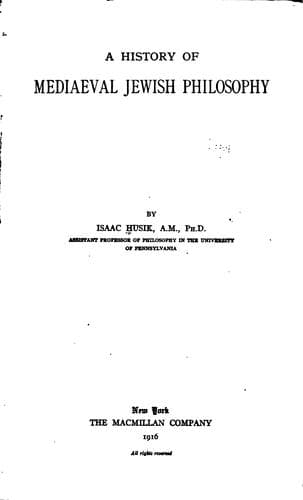
A History of Mediaeval Jewish PhilosophyHusik, Isaac
ReligionJewish
A History of Mediaeval Jewish Philosophy
Husik, Isaac
Philosophy, Jewish; Philosophy, Medieval
Then as to their ideas about immortality. If immortality is a necessary
phenomenon due to the intellectual nature of the soul and dependent upon
the degree of intellectual knowledge it possesses, how much knowledge
must a man have to be immortal? If any amount is sufficient, then every
rational soul is immortal, for everybody knows at least the axioms of
logic and mathematics, such as that things equal to the same thing are
equal to each other, that a thing cannot both be and not be, and so on.
If a knowledge of the ten categories is necessary, and of the other
universal principles which embrace existence conceptually, though not
practically, this knowledge can be gotten in a day, and it is not likely
that a man can become an angel in a day. If on the other hand one must
know everything not merely conceptually but in detail, no one can ever
acquire universal knowledge and no one is immortal The philosophers may
be excused because this is the best they can do with the help of pure
reason. We may commend them for their mode of life in accordance with
the moral law and in freedom from the world, since they were not bound
to accept our traditions. But it is different with us. Why should we
seek peculiar proofs and explanations for the immortality of the soul,
since we have promises to that effect whether the soul be corporeal or
spiritual? If we depend upon logical proof, our life will pass away
without our coming to any conclusion.[209]
Judah Halevi takes issue also with the Mutakallimun. These, as we know,
were Mohammedan theologians who, unlike the philosophers, were not
indifferent to religion. On the contrary their sole motive in
philosophizing was to prove the dogmas of their faith. They had no
interest in pure speculation as such. Judah Halevi has no more sympathy
with them than with the philosophers. Owing to the fact that the
Karaites were implicit followers of the Kalam and for other reasons, no
doubt, more objective, he thinks less of them than he does of the
philosophers. The only possible use, he tells us, of their methods is to
afford exercise in dialectics so as to be able to answer the arguments
of unbelievers. To the superficial observer the Mutakallim may seem to
be superior to the prophet, because he argues, whereas the latter
affirms without proving. In reality, however, this is not so. The aim of
the Mutakallim is to acquire the belief which the prophet has by nature.
But his Kalam may injure his belief instead of confirming it, by reason
of the many difficulties and doubts it introduces. The prophet, who has
natural belief, teaches not by means of dialectic discussion. If one has
a spark of the true belief in his nature, the prophet by his personality
will benefit him by a slight hint. Only he who has nothing of true
belief in his nature must have recourse to Kalam, which may benefit him
or injure.
Public-domain text, read in full here on John Shaqi.
Reviews
Reviews
No reviews yet
Be the first to share your thoughts on this work.
Elsewhere in the archive
Join the Discussion
Join the discussion
Sign in to leave a comment or review.
Sign InorCreate an account