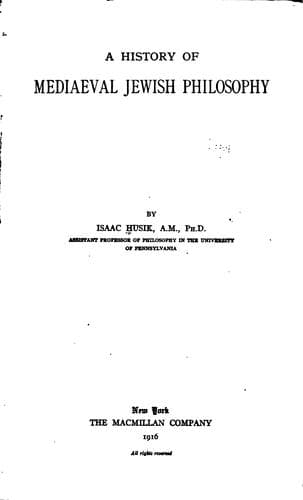
A History of Mediaeval Jewish PhilosophyHusik, Isaac
ReligionJewish
A History of Mediaeval Jewish Philosophy
Husik, Isaac
Philosophy, Jewish; Philosophy, Medieval
Judah Halevi follows up this general comment by a brief sketch of the
system of the Kalam, but we need not enter into this matter as there is
little there that we do not already know, and there is no detailed
criticism on the part of Judah Halevi.[210]
The Rabbi concludes his discourse with the king of the Chazars by
declaring his intention to leave the land in order to go to Jerusalem.
Although the visible Shekinah is no longer in Palestine, the invisible
and spiritual presence is with every born Israelite of pure heart and
deed; and Palestine is the fittest land for this communion, being
conducive to purity of heart and mind.[211]
CHAPTER XI
MOSES AND ABRAHAM IBN EZRA
_1. Moses ibn Ezra_
Among the Jewish Neo-Platonists must be included the two Ibn Ezras,
Moses and Abraham. They were contemporary and came from Spain. Moses,
the older of the two, was born at Granada about 1070 and died after
1138. Abraham, who travelled all over the world, was born at Toledo in
1092 and died in 1167. Neither is particularly famous as a philosopher.
Moses's celebrity rests on his poetic productions, secular as well as
religious, which are highly praised by Harizi, above even those of
Halevi. Abraham is best known as a grammarian and Biblical commentator,
particularly the latter, though his versatility is remarkable. Besides
grammar and exegesis he wrote on mathematics, astronomy and astrology,
on religious philosophy, and was a poet of no mean order; though, as
Zunz says,[212] "flashes of thought spring from his words, but not
pictures of the imagination."
All that is accessible in print of Moses Ibn Ezra's philosophical
treatise is a Hebrew translation of extracts under the title "Arugat
ha-Bosem" (Bed of Spices).[213] If we may judge of the rest of the work
by these Hebrew fragments, we should say that philosophy was not Ibn
Ezra's forte. He dabbled in it as any poet of that age did, but what
caught his fancy was more the mysteriously sounding phrases of
celebrated authorities like Pythagoras, Empedocles, Socrates, Plato,
Aristotle, Hermes (whom he identifies with Enoch), than a strictly
reasoned out argument. Accordingly the Hebrew selections consist of
little more than a string of quotations on the transcendence and
unknowableness of God, on the meaning of philosophy, on the position of
man in the universe, on motion, on nature and on intellect. It is of
historical interest to us to know that Moses ibn Ezra, so famous as a
poet, was interested in philosophy, and that the views which appealed to
him were those of Ibn Gabirol, whose "Fountain of Life" he knew, and
from which he quotes a celebrated mystical passage. A few details will
suffice to make this clear.
Public-domain text, read in full here on John Shaqi.
Reviews
Reviews
No reviews yet
Be the first to share your thoughts on this work.
Elsewhere in the archive
Join the Discussion
Join the discussion
Sign in to leave a comment or review.
Sign InorCreate an account