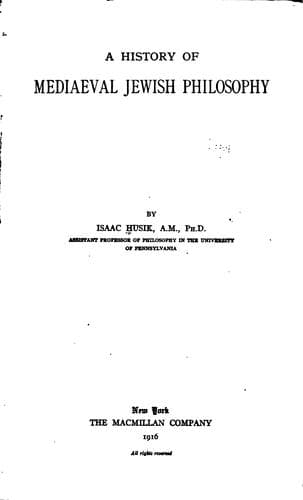
A History of Mediaeval Jewish PhilosophyHusik, Isaac
ReligionJewish
A History of Mediaeval Jewish Philosophy
Husik, Isaac
Philosophy, Jewish; Philosophy, Medieval
Abraham Ibn Ezra did not write any special work on philosophy, and his
importance lies chiefly in his Biblical commentary, which unlike that of
Rashi, is based upon a scientific and philological foundation. Ibn Ezra
was thoroughly familiar with Arabic and well versed in the philological,
scientific and philosophical studies cultivated by Arabs and Jews in his
native land. For reasons not known to us--poverty was very likely one of
them--he left his native Spain and wandered as far as Rome in the east,
Egypt and Morocco in the south, and London in the north. Everywhere he
was busy with literary activity, and as he wrote in Hebrew his purpose
must have been, as the result certainly proved to be, the enlightenment
of the non-Arabic speaking Jews of England, France and Italy, by
bringing before them in a language that they knew the grammar of Hayyuj,
the mathematics and astronomy of the Greeks and the Arabs, the
philosophy of Neo-Platonism, and the scientific and rationalistic spirit
generally, as enlightened Spain had developed it in Jew and Arab alike.
We are interested here more particularly in Ibn Ezra's philosophical
views. These are scattered through his Biblical commentaries and in a
few other small works devoted to an investigation of the laws of the
Pentateuch and the meaning of the names of God.[214] For though Ibn Ezra
favors the philological method as the best way to arrive at the true
meaning of Scripture, and decries allegory as well as Midrash when
pushed too far, and though his commentary is for the most part based
upon the philological method of interpretation, he was too much a child
of his age to be able to refrain from finding in the Bible views akin to
those he learned from Gabirol, the Brethren of Purity and what other
philosophical literature of the Arabs he read and was influenced by. And
so he, too, the grammarian and philologist, succumbed to the allegorical
and symbolical method he condemned. Without denying the historical
reality of the Garden of Eden, the Tree of Knowledge and the Tree of
Life, he also sees in these expressions symbols of cosmological,
psychological and ethical ideas. In the fashion of Philo he sees in Eden
a representation of the higher world of the divinity, in the Garden the
intermediate world of the spheres and Intelligences, in the river
issuing from the Garden the substance of the sublunar world, in the four
heads into which the river divides the four elements, and so on. He
speaks of these symbolic meanings as the "secrets," and so we have the
secret of the Garden, of the rivers, of the coats. And in the same way
he speaks of the secret of the Cherubim, of the ark and the Tabernacle.
These objects also symbolize metaphysical and cosmological truths. He
was a believer in astrology, and laid this pseudo-science also under
contribution in the interpretation of Holy Writ. Here the various
numbers found in the Bible in connection with ritual prescriptions, the
Public-domain text, read in full here on John Shaqi.
Reviews
Reviews
No reviews yet
Be the first to share your thoughts on this work.
Elsewhere in the archive
Join the Discussion
Join the discussion
Sign in to leave a comment or review.
Sign InorCreate an account