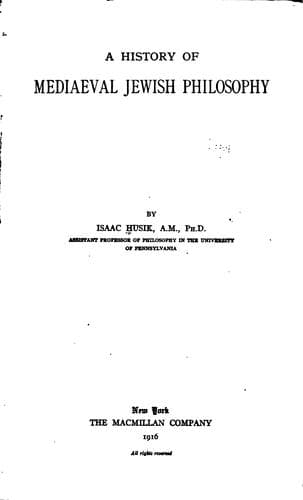
A History of Mediaeval Jewish PhilosophyHusik, Isaac
ReligionJewish
A History of Mediaeval Jewish Philosophy
Husik, Isaac
Philosophy, Jewish; Philosophy, Medieval
construction of the Tabernacle, and so on, were of great service to Ibn
Ezra in his symbolizations. Like Philo and the Neo-Pythagoreans he
analyzes the virtues and significances of the different numbers, and
thus finds a symbol in every number found in the Bible. Writing as he
did for the Jews of central Europe, who were not trained in secular
science and philosophy, Ibn Ezra was not prepared to shock the
sensibilities of his readers by his novel and, to them, heretical views;
and hence he expressed himself in cryptic phrases and allusions, which
often make his meaning difficult if not impossible to decipher. This,
taken together with the fact that his views are not laid down anywhere
systematically and in connected fashion, but are thrown out briefly,
often enigmatically, in connection with the explanation of Biblical
verses and phrases, accounts for the difference among critics concerning
the precise doctrines of Abraham Ibn Ezra.
Of his predecessors among the Jewish philosophers Ibn Ezra shows closest
relation to Solomon ibn Gabirol. He does not quote the "Fountain of
Life," but he names its author as a great thinker and writer of poems,
and shows familiarity with Gabirol's doctrines. Like Gabirol he says
that all except God consists of substance (matter) and form. Not only
the sublunar things, subject to generation and decay, but the higher
incorporeal things, also, are in essence two, _i. e._, are composed of
two elements, subject and predicate. God alone is One; he is subject
only and not predicate. And Ibn Ezra also has some allusion to the
divine Will as taught by Gabirol.
In giving a connected sketch of Ibn Ezra's philosophical ideas, the most
one can do is to collect all the sayings bearing upon our subject which
are found scattered through Ibn Ezra's writings, and classify them and
combine them into a connected whole. This has been done before by Nahman
Krochmal[215] and by David Rosin,[216] and we shall follow the latter in
our exposition here.
Public-domain text, read in full here on John Shaqi.
Reviews
Reviews
No reviews yet
Be the first to share your thoughts on this work.
Elsewhere in the archive
Join the Discussion
Join the discussion
Sign in to leave a comment or review.
Sign InorCreate an account