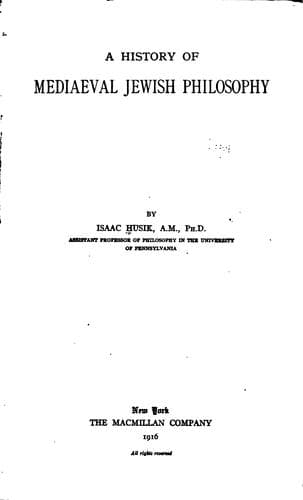
A History of Mediaeval Jewish PhilosophyHusik, Isaac
ReligionJewish
A History of Mediaeval Jewish Philosophy
Husik, Isaac
Philosophy, Jewish; Philosophy, Medieval
God is the One. He gives forms to all things, and is himself all things.
God alone is the real existent, all else is an existent by virtue of
him. Unity is the symbol of God because in number also the unit is the
foundation of all number, and yet is not itself number. It exists by
virtue of itself and needs not the numbers that come after. At the same
time the unit is also all number, because all number is made up of the
unit. God alone is one, because he alone is not composed of matter and
form, as everything else is. God has neither likeness nor form, for he
is the creator of all things, _i. e._, of all likeness and form. He is
therefore incorporeal. In God the subject knowing and the object of his
knowledge are one and the same thing. Else he would not be one. In
knowing himself, therefore, he knows the universe. God as the cause and
creator of all things must know all things, the universal as well as the
particular, the world soul as well as the various species, and even
every single creature, but he knows the particular in a general way. For
God knows only what is permanent, whereas the particular is constantly
changing, hence he does not know the particular as such, but only as
involved in the general and permanent.
As God is incorporeal he is not subject to corporeal accidents or human
feelings. Hence the many expressions in the Bible which ascribe such
accidents and feelings to God must be understood as metaphors. It is a
psychological necessity for man wishing to communicate his ideas to
other men to speak in human terms, whether he speak of beings and things
inferior or superior to him. The result is that the metaphor he finds it
necessary to employ either raises or lowers the object to which it
refers. It elevates the sub-human and lowers the superhuman to the
human. This is the explanation of such phrases as "the mouth of the
earth" the "hand of the Jordan," the "head of the dust of the world,"
and so on, in which the figure is that of personification. And the
fundamental explanation is the same in such phrases as "The Lord
repented," "The Lord rested," "The Lord remembered," "He that dwelleth
in heaven laughs," and so on, where the process is the reverse of
personification. The motive common to both is to convey some idea to the
reader.
Public-domain text, read in full here on John Shaqi.
Reviews
Reviews
No reviews yet
Be the first to share your thoughts on this work.
Elsewhere in the archive
Join the Discussion
Join the discussion
Sign in to leave a comment or review.
Sign InorCreate an account