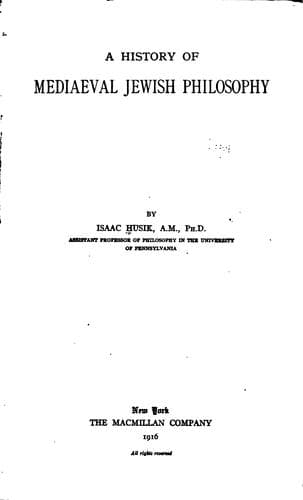
A History of Mediaeval Jewish PhilosophyHusik, Isaac
ReligionJewish
A History of Mediaeval Jewish Philosophy
Husik, Isaac
Philosophy, Jewish; Philosophy, Medieval
The laws may also be classified as 1. Commandments of the heart, 2.
Commandments of the tongue, and 3. Commandments of action. An example of
commandments of the heart is, "Thou shalt love the Lord thy God," "Thou
shalt not hate thy brother in thy heart," and so on. To the commandments
of the tongue belong the reading of the _Shema_, grace after meals, the
priestly benediction, and so on. The laws of the third class are so
numerous that there is no need of mentioning them. The laws of the heart
are the most important of all. The reader will recognize in this
two-fold classification Saadia's division of the laws into rational and
traditional, and Bahya's classification of duties of the heart and
duties of the limbs. This second class includes Ibn Ezra's second and
third classes, tongue and action.[219]
The problem of evil Ibn Ezra solves by saying that from God comes good
only. The world as a whole is good; evil is due to the defect of the
object receiving higher influence. To argue that because of the small
part of evil the whole world, which is good, should not have been
created, is foolish.
The highest good of man is to develop his reason. As the traveller and
the captive long to return to the land of their birth and be with their
family, so the rational soul is eager to rise to the upper world which
is not made of clay. This it can do only if it purifies itself from the
uncleanness of corporeal desire which drags it down, and takes pains to
know its own nature and origin, with the help of Wisdom whose eyes are
undimmed. Then she will know the truth, which will remain indelibly
impressed upon her when she separates from the body, where she was put
for her own good. The suffering she underwent here for a time will give
place to everlasting rest and joy. All man's work is vain, for man can
neither create nor annihilate a substance. All his corporeal activity
consists in combination and separation of accidents. The only thing of
value is the fear of God. But no man can rise to this stage until he has
ascended the ladder of wisdom, and has acquired understanding.[220]
More concretely the way to purify the soul from the body is by uniting
the rational and spirited soul, as Plato has it, against the appetitive,
and giving the reason the mastery over the spirited soul as well. A
moderate degree of asceticism is to be recommended as favoring the
emancipation of the soul from the tyranny of the body. This is the
meaning of the institution of the Nazirite; and the offering he must
bring after the expiration of his period is to atone for the sin of
returning to a life of indulgence. But one should not go to extremes.
Too much praying and fasting results in stupefaction. It is a mistake to
develop one side of one's nature at the expense of another. Every one
of the three souls (the rational, the spirited and the appetitive) must
be given its due.
Public-domain text, read in full here on John Shaqi.
Reviews
Reviews
No reviews yet
Be the first to share your thoughts on this work.
Elsewhere in the archive
Join the Discussion
Join the discussion
Sign in to leave a comment or review.
Sign InorCreate an account