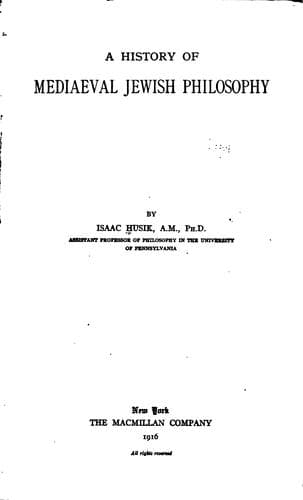
A History of Mediaeval Jewish PhilosophyHusik, Isaac
ReligionJewish
A History of Mediaeval Jewish Philosophy
Husik, Isaac
Philosophy, Jewish; Philosophy, Medieval
The highest good of man, we have seen, is the knowledge of God and his
work. There are two ways of knowing God. One is through a study of
nature, the work of God. This is described in the first part of the
nineteenth Psalm, "The Heavens declare the glory of God; and the
firmament showeth his handiwork." But there is a second and, in a sense,
a better way of knowing God. This is derived from his revelation in the
Law. As we are told in the second part of the above Psalm (_v._ 7), "The
law of the Lord is perfect, restoring the soul." The law of the Lord
restores the soul, Ibn Ezra says, by removing doubt from it. For the
first method of knowing God, with all its importance for the man of
wisdom and reason, is not fit for all persons; and not everything can be
proved by reason. Revelation in the Law is necessary for the simple
minded. "I am the Lord thy God" (Exod. 20, 2) is a hint to the
philosopher, who need not depend on hearsay, for real knowledge is
proved knowledge. But as not everyone is in a position to have such
knowledge, the Bible adds, "which brought thee out of the land of
Egypt." This all can understand, the simple minded as well as the
philosopher. The Law has also a practical purpose, to strengthen the
rational soul so as to prevent the body from gaining the upper hand.
God's messenger, through whom his will is made known, is the prophet. He
seeks retirement so as to get in communion with God, and receives such
influence as he is capable of getting. Moses was the greatest of the
prophets. He was able to communicate with God whenever he chose, whereas
the others had to wait until the inspiration came. The revelation of God
to Moses was without an intermediary, and without visions and
likenesses. Moses saw the things presented to him in their true form.
The laws may be divided into 1. Innate or rational laws, _i. e._, laws
planted by God in the mind of every rational being. There are many such
in the Torah. All the laws of the Ten Commandments belong to this class,
with the exception of the Sabbath. Hence all mankind believe in them,
and Abraham observed them all before ever the Law was given on Sinai. 2.
Hidden laws, _i. e._, laws, the reason of which is not given. We must
not suppose for a moment that there is any law which is against reason,
Heaven forbid! We must observe them all, whether we understand the
reason or not. If we find a law that apparently is unreasonable, we must
assume that it has some hidden meaning and is not to be taken in its
literal sense. It is our duty, then, to look for this hidden meaning,
and if we cannot find it, we must admit that we do not understand it.
Public-domain text, read in full here on John Shaqi.
Reviews
Reviews
No reviews yet
Be the first to share your thoughts on this work.
Elsewhere in the archive
Join the Discussion
Join the discussion
Sign in to leave a comment or review.
Sign InorCreate an account