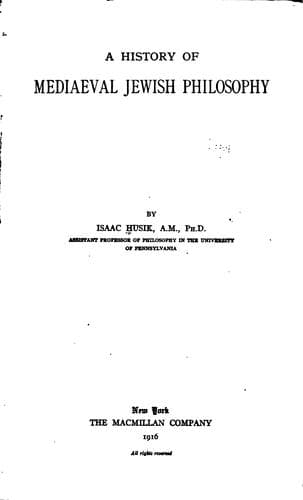
A History of Mediaeval Jewish PhilosophyHusik, Isaac
ReligionJewish
A History of Mediaeval Jewish Philosophy
Husik, Isaac
Philosophy, Jewish; Philosophy, Medieval
Accordingly Ibn Daud follows his physical doctrines with a discussion of
the soul. There is nothing new in his proof that such a thing as soul
exists. It is identical with the deduction of Joseph Ibn Zaddik
(_supra_, p. 134). Stone and tree and horse and man are all bodies and
yet the last three have powers and functions which the stone has not,
_viz._, nutrition, growth and reproduction. Horse and man have in
addition to the three powers above mentioned, which they have in common
with tree, the powers of sensation and motion and imagination, which
plants have not. Finally man is distinguished above all the rest of
animal creation in possessing the faculty of intelligence, and the
knowledge of art and of ethical discrimination. All these functions
cannot be body or the result of body, for in that case all corporeal
objects should have all of them, as they are all bodies. We must
therefore attribute them to an extra-corporeal principle; and this we
call soul. As an incorporeal thing the soul cannot be strictly defined,
not being composed of genus and species; but we can describe it in a
roundabout way in its relation to the body. He then gives the
Aristotelian definition of the soul as "the [first] entelechy of a
natural body having life potentially" (_cf._ above, p. xxxv).
Like many of his predecessors who treated of the soul, Ibn Daud also
finds it necessary to guard against the materialistic theory of the soul
which would make it the product of the elemental mixture in the body, if
not itself body. This would reduce the soul to a phenomenon of the body,
or in Aristotelian terminology, an accident of the body, and would
deprive it of all substantiality and independence, not to speak of
immortality. How can that which is purely a resultant of a combination
of elements remain when its basis is gone? Accordingly Ibn Daud takes
pains to refute the most important of these phenomenalistic theories,
that of Hippocrates and Galen. Their theory in brief is that the
functions which we attribute to the soul are in reality the results of
the various combinations of the four elementary qualities, hot, cold,
moist, dry. The more harmonious and equable the proportion of their
union, the higher is the function resulting therefrom. The difference
between man and beast, and between animal and plant is then the
difference in the proportionality of the elemental mixture. They prove
this theory of theirs by the observation that as long as the mixture is
perfect the activities above mentioned proceed properly; whereas as soon
as there is a disturbance in the mixture, the animal becomes sick and
cannot perform his activities, or dies altogether if the disturbance is
very great. The idea is very plausible and a great many believe it, but
it is mistaken as we shall prove.
Public-domain text, read in full here on John Shaqi.
Reviews
Reviews
No reviews yet
Be the first to share your thoughts on this work.
Elsewhere in the archive
Join the Discussion
Join the discussion
Sign in to leave a comment or review.
Sign InorCreate an account