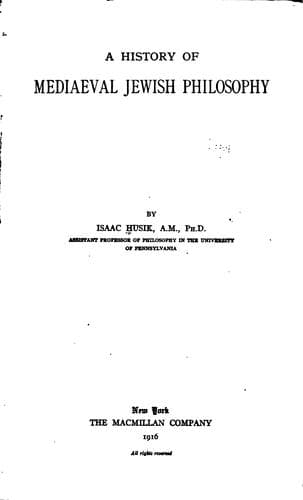
A History of Mediaeval Jewish PhilosophyHusik, Isaac
ReligionJewish
A History of Mediaeval Jewish Philosophy
Husik, Isaac
Philosophy, Jewish; Philosophy, Medieval
Ibn Daud may have been aware of the inadequacy of his argument from
motion, and therefore he adds another, based upon the distinction
between the "possible existent" and the "necessary existent"--a
distinction and an argument due to Alfarabi and Avicenna. A possible
existent is a thing whose existence depends upon another, and was
preceded by non-existence. It may exist or not, depending upon its
cause; hence the name _possible_ existent. A necessary existent is one
whose existence is in itself and not derived from elsewhere. It is a
necessary existent because its own essence cannot be thought without
involving existence. Now the question is, Is there such a thing as a
necessary existent, or are all existents merely possible? If all
existents are possible, we have an infinite series, every link of which
is dependent for its existence upon the link preceding it; and so long
as there is no first there is nothing to explain the existence of any
link in the chain. We must therefore assume a first, which is itself not
again dependent upon a cause prior to it. This is by definition a
necessary existent, which is the cause of the existence of everything
else. This proof is compatible with God as a Creator.
Having shown the existence and incorporeality of God we must now prove
his unity. We shall base this proof upon the idea of the necessary
existent. Such an existent cannot have in it any multiplicity; for if it
has, its own essence would not be able to keep the elements together,
and there would be need of an external agent to do this. But in this
case the object would be dependent upon something else, which is
incompatible with the idea of a necessary existent.
Nor is it possible there should be two necessary existents; for the
necessary existent, we have just shown, must be of the utmost
simplicity, and hence cannot have any attribute added to its essence.
Now if there is a second, there must be something by which the first
differs from the second, or they are identical. Either the first or the
second therefore would not be completely simple, and hence not a
necessary existent.
Public-domain text, read in full here on John Shaqi.
Reviews
Reviews
No reviews yet
Be the first to share your thoughts on this work.
Elsewhere in the archive
Join the Discussion
Join the discussion
Sign in to leave a comment or review.
Sign InorCreate an account