A History of Mediaeval Jewish Philosophy — John Shaqi
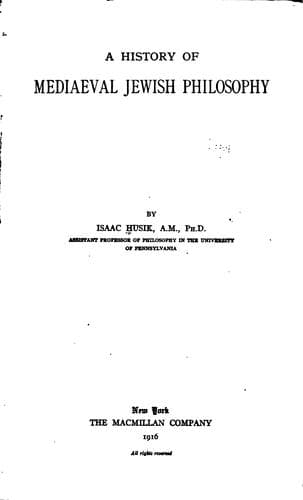
A History of Mediaeval Jewish PhilosophyHusik, Isaac
ReligionJewish
A History of Mediaeval Jewish Philosophy
Husik, Isaac
Philosophy, Jewish; Philosophy, Medieval
When Aristotle began to be studied in his larger treatises and the
details of the psychology and the metaphysics became known especially
through Averroes, we find among the Jews also an interest in the finer
points of the problem of knowledge. The motives of Plato's idealism and
Aristotle's conceptualism (if this inexact description may be allowed
for want of a more precise term) are discussed with fulness and detail
by Levi ben Gerson. He realizes the difficulty involved in the problem.
Knowledge must be of the real and the permanent. But the particular is
not permanent, and the universal, which is permanent, is not real. Hence
either there is no knowledge or there is a reality corresponding to the
universal concept. This latter was the view adopted by Plato. Gersonides
finds the reality in the thoughts of the Active Intellect, agreeing in
this with the views of Philo and Augustine, substituting only the Active
Intellect for their Logos. Maimonides does not discuss the question, but
it is clear from a casual statement that like Aristotle he does not
believe in the independent reality of the universal (Guide III, 18).
In theoretical physics the Arabian Mutakallimun, we have seen (p. xxii),
laid great stress on the theory of atom and accident as opposed to the
concepts of matter and form by which Aristotle was led to believe in the
eternity of the world. Accordingly every Mutakallim laid down his
physical theory and based on it his proof of creation. This method was
followed also by the early Jewish thinkers. The Karaites before
Maimonides adopted the atomic theory without question. And Aaron ben
Elijah, who had Maimonides's "Guide" before him, was nevertheless
sufficiently loyal to his Karaite predecessors to discuss their views
side by side with those of the Aristotelians and to defend them against
the strictures of Maimonides. Saadia, the first Rabbanite philosopher,
discusses no less than thirteen erroneous views concerning the origin
and nature of the world, but he does not lay down any principles of
theoretical physics explicitly. He does not seem to favor the atomic
theory, but he devotes no special treatment to the subject, and in his
arguments for creation as opposed to eternity he makes use of the
Kalamistic concepts of substance and accident and composition and
division. The same is true of Bahya Ibn Pakuda. Joseph Ibn Zaddik is
the first who finds it necessary to give an independent treatment of the
sciences before proceeding to construct his religious philosophy, and in
so doing he expounds the concepts of matter and form, substance and
accident, genesis and destruction, the four elements and their natures
and so on--all these Aristotelian concepts. Ibn Daud follows in the path
of Ibn Zaddik and discusses the relevant concepts of potentiality and
actuality and the nature of motion and infinity, upon which his proof is
based of the existence of God. Maimonides clears the ground first by a
Public-domain text, read in full here on John Shaqi.
Reviews
Reviews
No reviews yet
Be the first to share your thoughts on this work.
Join the Discussion
Join the discussion
Sign in to leave a comment or review.
Sign InorCreate an account