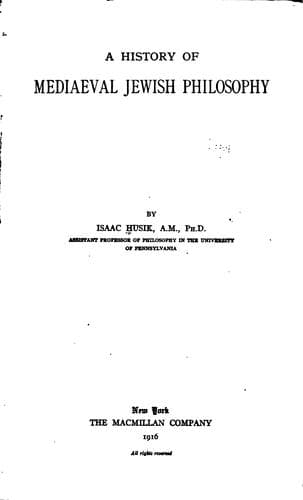
A History of Mediaeval Jewish PhilosophyHusik, Isaac
ReligionJewish
A History of Mediaeval Jewish Philosophy
Husik, Isaac
Philosophy, Jewish; Philosophy, Medieval
The practical part of philosophy, ethics, the Mutakallimun among the
Arabians discussed in connection with the justice of God. In opposition
to the Jabariya and the Ashariya who advocated a fatalistic determinism
denying man's ability to determine his own actions, some going so far as
to say that right and wrong, good and evil, are entirely relative to
God's will, the Muʿtazila insisted that man is free, that good and evil
are absolute and that God is just because justice is inherently right,
injustice inherently wrong. Hence reward and punishment would be unjust
if man had not the freedom to will and to act. The Karaites Joseph Al
Basir and Jeshua ben Judah discuss the problem of the nature of good and
evil and vindicate their absolute character. God desires the good
because it is good, and it is not true that a thing is good because God
has commanded it. Freedom of man is a corollary of the goodness of God.
The Rabbanites take it for granted that good is good inherently, and
God desires and commands it because it is identical with his wisdom and
his will. Freedom of man does follow as a corollary from the justice of
God and it is also taught in the Bible and the Talmud. The very fact of
the existence of a divine law and commandments shows that man has
freedom. And those passages in Scripture which seem to suggest that God
sometimes interferes with man's freedom are explained away by
interpretations _ad hoc_. Our own consciousness of power to determine
our acts also is a strong argument in favor of freedom. Nevertheless the
subject is felt to have its difficulties and the arguments against free
will taken from the causal sequences of natural events and the influence
of heredity, environment and motive on the individual will are not
ignored. Judah Halevi as well as Abraham Ibn Daud discuss these
arguments in detail. But freedom comes out triumphant. It is even sought
to reconcile the antinomy of freedom vs. God's foreknowledge. God knows
beforehand from all eternity how a given man will act at a given moment,
but his knowledge is merely a mirror of man's actual decision and not
the determining cause thereof. This is Judah Halevi's view. Abraham Ibn
Daud with better insight realizes that the contingent, which has no
cause, and the free act, which is undetermined, are as such
unpredictable. He therefore sacrifices God's knowledge of the contingent
and the free so as to save man's freedom. It is no defect, he argues,
not to be able to predict what is in the nature of the case
unpredictable. Maimonides cannot admit any ignorance in God, and takes
refuge in the transcendent character of God's knowledge. What is
unpredictable for us is not necessarily so for God. As he is the cause
of everything, he must know everything. Gersonides who, as we have seen,
is unwilling to admit Maimonides's agnosticism and transcendentalism,
solves the problem in the same way as Ibn Daud. God knows events in so
Public-domain text, read in full here on John Shaqi.
Reviews
Reviews
No reviews yet
Be the first to share your thoughts on this work.
Join the Discussion
Join the discussion
Sign in to leave a comment or review.
Sign InorCreate an account