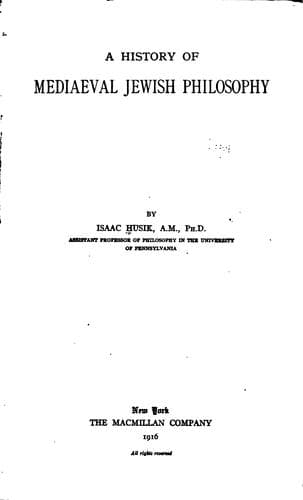
A History of Mediaeval Jewish PhilosophyHusik, Isaac
ReligionJewish
A History of Mediaeval Jewish Philosophy
Husik, Isaac
Philosophy, Jewish; Philosophy, Medieval
Among the peculiar phenomena of religion, and in particular of Judaism,
the one that occupies a fundamental position is the revelation of God's
will to man and his announcement of the future through prophetic
visions. Dreams and divination had already been investigated by
Aristotle and explained psychologically. The Arabs made use of this
suggestion and endeavored to bring the phenomenon of prophecy under the
same head. The Jewish philosophers, with the exception of Judah Halevi
and Hasdai Crescas, followed suit. The suggestion that prophecy is a
psychological phenomenon related to true dreams is found as early as
Isaac Israeli. Judah Halevi mentions it with protest. Abraham Ibn Daud
adopts it, and Maimonides gives it its final form in Jewish
rationalistic philosophy. Levi ben Gerson discusses the finer details of
the process, origin and nature of prophetic visions. In short the
generally accepted view is that the Active Intellect is the chief agent
in communicating true visions of future events to those worthy of the
gift. And to become worthy a combination of innate and acquired powers
is necessary together with the grace of God. The faculties chiefly
concerned are reason and imagination. Moral excellence is also an
indispensable prerequisite in aiding the development of the theoretical
powers.
Proceeding to the more dogmatic elements of Judaism, Maimonides was the
first to reduce the 613 commandments of Rabbinic Judaism to thirteen
articles of faith. Hasdai Crescas criticised Maimonides's principle of
selection as well as the list of dogmas, which he reduced to six. And
Joseph Albo went still further and laid down three fundamental dogmas
from which the rest are derived. They are the existence of God,
revelation of the Torah and future reward and punishment.
The law of Moses is unanimously accepted as divinely revealed. And in
opposition to the claims of Christianity and Mohammedanism an endeavor
is made to prove by reason as well as the explicit statement of
Scripture that a divine law once given is not subject to repeal. The
laws are divided into two classes, _rational_ and _traditional_; the
former comprising those that the reason approves on purely rational and
ethical grounds, while the latter consist of such ceremonial laws as
without specific commandment would not be dictated by man's own reason.
And in many of these commandments no reason is assigned. Nevertheless an
endeavor is made to rationalize these also. Bahya introduced another
distinction, viz., the "duties of the heart," as he calls them, in
contradistinction to the "duties of the limbs." He lays stress on
intention and motive as distinguished from the mere external observance
of a duty or commandment.
Public-domain text, read in full here on John Shaqi.
Reviews
Reviews
No reviews yet
Be the first to share your thoughts on this work.
Join the Discussion
Join the discussion
Sign in to leave a comment or review.
Sign InorCreate an account