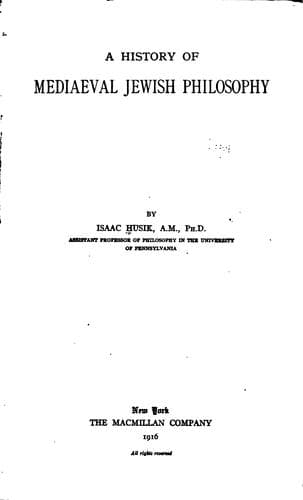
A History of Mediaeval Jewish PhilosophyHusik, Isaac
ReligionJewish
A History of Mediaeval Jewish Philosophy
Husik, Isaac
Philosophy, Jewish; Philosophy, Medieval
In order to show that God is not to be compared to any other thing in
creation Saadia finds it convenient to use Aristotle's classification of
all existing things under the ten categories.[66] Everything that exists
is either a substance, or it is an accident, _i. e._, an attribute or
quality of a substance. Substance is therefore the first and most
important of the categories and is exemplified by such terms as man,
horse, city. Everything that is not substance is accident, but there are
nine classes of accident, and with substance they make up the ten
categories. The order of the categories as Aristotle gives them in his
treatise of the same name is, substance, quantity, quality, relation,
place, time, position, possession, action, passion. If these categories
include all existing things and we can prove that God is not any of
them, our object is accomplished. The one general argument is one with
which we are already familiar. It is that God is the cause of all
substance and accident, hence he is himself neither the one nor the
other. Scripture supports our view, as in Deuteronomy 4, 15: "Take ye
therefore good heed of yourselves; for ye saw no manner of form on the
day that the Lord spake unto you in Horeb out of the midst of the fire:
lest ye corrupt yourselves, and make you a graven image in the form of
any figure, the likeness of male or female, the likeness of any beast
that is on the earth, the likeness of any winged fowl that flieth in the
heaven; the likeness of anything that creepeth on the ground, the
likeness of any fish that is in the water under the earth: and lest thou
lift up thine eyes unto heaven, and when thou seest the sun and the moon
and the stars, even all the host of heaven, thou be drawn away," etc.
And tradition is equally emphatic in this regard. Our sages, who were
the disciples of the prophets, render the anthropomorphic passages in
the Bible so as to avoid an objectionable understanding. This is
particularly true of the Aramaic translation of the Targum.
Such terms as head, eye, ear, mouth, lip, face, hand, heart, bowels,
foot, which are used in relation to God in the Bible, are figurative.
For it is the custom of language to apply such terms metaphorically to
certain ideas like elevation, providence, acceptance, declaration,
command, favor, anger, power, wisdom, mercy, dominion. Language would be
a very inadequate instrument if it confined itself to the literal
meaning of the words it uses; and in the case of God we should be
limited to the statement that he is.
What was said of the nouns above mentioned applies also to other parts
of speech, such as verbs attributing human activity to God. Such phrases
as "incline thine ear," "open thine eyes," "he saw," "he heard," "he
spoke" are figurative. So the expression, "the Lord smelled," which
sounds especially objectionable, denotes acceptance.
Public-domain text, read in full here on John Shaqi.
Reviews
Reviews
No reviews yet
Be the first to share your thoughts on this work.
Elsewhere in the archive
Join the Discussion
Join the discussion
Sign in to leave a comment or review.
Sign InorCreate an account