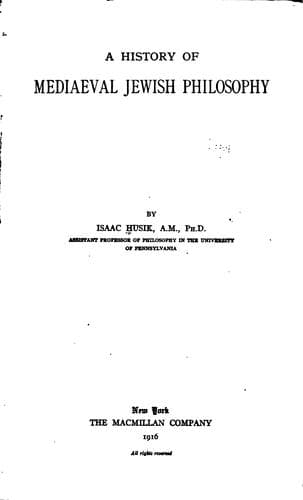
A History of Mediaeval Jewish PhilosophyHusik, Isaac
ReligionJewish
A History of Mediaeval Jewish Philosophy
Husik, Isaac
Philosophy, Jewish; Philosophy, Medieval
The theophanies in the Bible, where God is represented under a certain
form, as in Ezekiel, Isaiah and Kings, do not argue against our view,
for there are meant specially created forms for the benefit and honor of
the prophet. This is what is meant by the "Glory of the Lord," and
"Shekinah." Sometimes it is simply a created light without an individual
form. When Moses asked to see God, he meant the created light. God
cannot be seen with the eye nor can he be grasped in thought or
imagination. Hence Moses could not have meant to see God, but the
created light. His face was covered so that he should not be dazzled by
the exceeding splendor of the beginning of the light, which is too much
for a mortal to endure; but later when the brightest part passed by,
the covering was taken off and Moses saw the last part of the light.
This is the meaning of the expression in Exodus 33, 23, "And I will take
away mine hand, and thou shalt see my back: but my face shall not be
seen."
Having treated of God as the creator of the world and having learned
something about his attributes, we must now proceed to the study of man,
or which is the same thing, to an investigation of God's relations to
the rational part of his creation in the sublunar world. That man is
endowed with a soul cannot be doubted, for the activities of man's soul
are directly visible. The problem which is difficult is concerning the
nature of the soul.[67] Here opinions differ, and some regard the soul
as an accident of the body, some think it is a corporeal substance like
air or fire, while others believe there is more than one soul in man. It
will be our task to vindicate our own view against these erroneous
ideas. The soul is too important in its functions to be an accident. It
is neither air nor fire because it has not the properties of these
bodies. And if the soul consisted of two or more distinct parts, the
perceptions of sense would not reach the reason, and there would be no
co-operation between these two powers. The true view is therefore that
the soul of man is a substance created by God at the time when the human
body is completed. The soul has no eternal existence before the body as
Plato thought, for nothing is eternal outside of God, as we saw before.
Nor does it enter the soul from the outside, but is created with and in
the body. Its substance is as pure as that of the celestial spheres,
receiving its light like them, but is much finer than the substance of
the spheres, for the latter are not rational, whereas the soul is. The
soul is not dependent for its knowledge upon the body, which without the
latter has neither life nor knowledge, but it uses the body as an
instrument for its functions. When connected with the body the soul has
three faculties, reason, spirit and desire. But we must not think with
Plato that these powers form so many divisions or parts of the soul,
residing in different parts of the body. All the three faculties belong
Public-domain text, read in full here on John Shaqi.
Reviews
Reviews
No reviews yet
Be the first to share your thoughts on this work.
Elsewhere in the archive
Join the Discussion
Join the discussion
Sign in to leave a comment or review.
Sign InorCreate an account