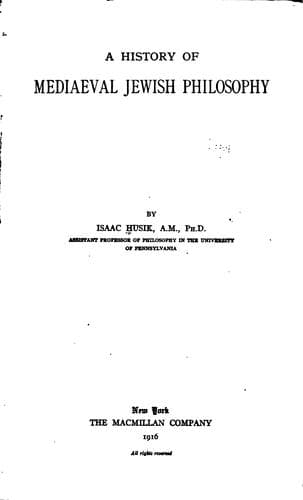
A History of Mediaeval Jewish PhilosophyHusik, Isaac
ReligionJewish
A History of Mediaeval Jewish Philosophy
Husik, Isaac
Philosophy, Jewish; Philosophy, Medieval
With regard to the condition of the soul after death and the nature of
reward and punishment in the next world, there is a variety of opinions.
Those who hold that the soul is corporeal or that it is an accident of
the body believe it is destroyed with the death of the body. We have
already refuted their opinion. Others, like the Platonists, the Dualists
and the Pantheists, who believe in the pre-existence of the soul either
as a separate entity or as a part of God, hold that after the death of
the body the soul returns to its original condition. Our belief as
stated above (p. 37) is opposed to this. But there are some calling
themselves Jews who believe in metempsychosis, that the soul migrates
from one person to another and even from man to beast, and that in this
way it is punished for its sins and purged. They see a confirmation of
their view in the fact that some persons exhibit qualities which are
characteristic of lower animals. But this is absurd. The soul and the
body form a natural unit, the one being adapted to the other. A human
body cannot unite with the soul of an animal, nor an animal body with a
human soul. They try to account by their theory for the suffering of
little children, who could not have sinned in their own person. But we
have already explained that the suffering of children is not in the
nature of punishment, but with a view to subsequent reward, and they
must admit that the first placing of the soul in the body and giving it
commandments is not in the nature of compensation for any past merit,
but with a view to later reward. Why not then explain the suffering of
children in the same way?[75]
As the body and the soul form a natural unit during life and a man's
conduct is the combined effort of the two constituent parts of his
being, it stands to reason that future reward and punishment should be
imposed upon body and soul in combination. Hence the doctrine of the
resurrection of the body, which is alluded to in the Bible and made
into a religious dogma by the Rabbis, has support also in the
reason.[76] Many objections have been advanced against it, but they can
be easily answered. The strongest objection might seem to be that which
attempts to show that resurrection is a logical contradiction. The
argument is that the elements making up a given body during life find
their way after the death of the person into the body of another, to
which they are assimilated and of which they form a part. Hence it is
impossible to resurrect two bodies out of the material common to both.
But this argument is untrue to fact. Every human body has its own
matter, which never enters into the composition of any other body. When
the person dies and the body decomposes, each element returns to its
place in nature, where it is kept until the resurrection.
Public-domain text, read in full here on John Shaqi.
Reviews
Reviews
No reviews yet
Be the first to share your thoughts on this work.
Elsewhere in the archive
Join the Discussion
Join the discussion
Sign in to leave a comment or review.
Sign InorCreate an account