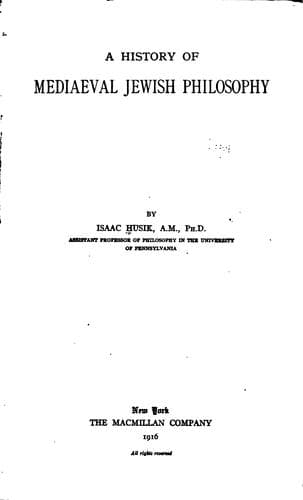
A History of Mediaeval Jewish PhilosophyHusik, Isaac
ReligionJewish
A History of Mediaeval Jewish Philosophy
Husik, Isaac
Philosophy, Jewish; Philosophy, Medieval
But there is another event which will happen to Israel before the time
of the resurrection. In accordance with the promises of the Prophets we
believe that Israel will be delivered from exile by the Messiah.[77]
Reason also supports this belief, for God is righteous, and since he has
placed us in exile partly as a punishment for wrongdoing, partly for the
purpose of trying us, there must be a limit to both.
Messiah the son of David will come, will deliver Jerusalem from the
enemy and settle there with his people. When all the believing
Israelites have been gathered from all the nations to the land of
Palestine, then will come the resurrection. The Temple will be rebuilt,
the light of the Shekinah will rest upon it, and the spirit of prophecy
will be vouchsafed to all Israel, young and old, master and servant.
This blessed period will last until the end of time, _i. e._, until this
world will give place to the next, which is the place of reward and
punishment.
We describe the future habitation and status of the soul as Garden of
Eden (Paradise) and Gehenna.[78] The former expression is intended to
suggest happiness, there being nothing pleasanter in the world than a
garden. The term Gehenna is associated in the Bible with Tofteh, which
was a place of impurity not far from the Temple. In reality, however,
God will create a substance which will combine light and heat in such a
way that the righteous will enjoy the light only, while the wicked will
be tortured by the heat. All this Saadia infers from Biblical passages.
There will be no eating and drinking in the next world, and hence no
need of a heaven and an earth like ours, but there will be place and
time, since creatures cannot do without it. There will be no succession
of day and night, for these are of use only for our present life and
occupations, but will be unnecessary there. There will, however, be a
special period for worship.
Reward and punishment in the next world will both be eternal. It stands
to reason that God should _promise_ eternal reward and punishment so as
to inspire mankind with the highest possible degree of hope and fear,
that they may have no excuse for not heeding the commandments so
forcibly impressed upon them. Having made the promise, his justice
prompts him to fulfil it, and those who suffer have themselves to blame.
Public-domain text, read in full here on John Shaqi.
Reviews
Reviews
No reviews yet
Be the first to share your thoughts on this work.
Elsewhere in the archive
Join the Discussion
Join the discussion
Sign in to leave a comment or review.
Sign InorCreate an account