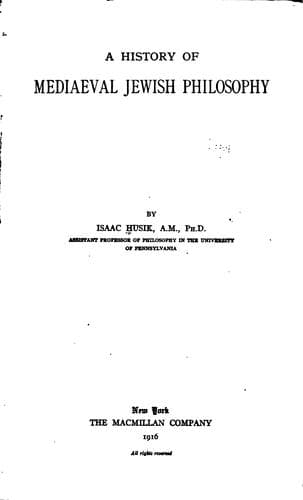
A History of Mediaeval Jewish PhilosophyHusik, Isaac
ReligionJewish
A History of Mediaeval Jewish Philosophy
Husik, Isaac
Philosophy, Jewish; Philosophy, Medieval
Our problem therefore is to prove the power and wisdom of God, which
will imply his existence. We cannot do this directly, for we cannot see
God. Hence the only method is to prove the existence of a powerful and
wise creator through his creation. We must prove his power in doing
things which we cannot do, such as the ability to create our bodies. But
for this it is necessary to show that our bodies--and the same will
apply to the other bodies of the world, and hence to the world as a
whole--were created, _i. e._, that there was a time when they were not.
This leads us to an analysis of the constituents of body. All bodies
consist of atoms and their "accidents," or conditions and qualities. The
primary accidents, which are presupposed by all the rest, are the
following four, combination, separation, motion and rest. Without these
no body can exist, for body is the result of a combination and
separation of atoms at rest or in motion. But combination and separation
are the acts of a combiner and separater, as we can infer from the
analogy of our own acts. Our acts have ourselves as their creators,
hence the acts visible in the combinations and separations of atoms to
form bodies must also have their creator.
The attributes of the creator we infer from the nature of his work. So
we call God "Powerful," meaning that he had the power to create the
world. As creation denotes power, so the success and harmony of the
product argues wisdom; and this power and wisdom thus established are
not disproved by an occasional production or event which is not perfect,
a monstrosity for example, or disease and suffering. We say in reference
to these that God must have a deeper object in view, to inspire mankind
with the fear of God, and in order to increase their reward in the next
world.
The attribute of Life follows from the other two, for life denotes the
possession or capacity of power and knowledge.
Thus al-Basir has the same three essential attributes as Saadia. His
proof of the existence of God is also identical with one of the proofs
of Saadia. But he shows himself a more loyal follower of the Kalam by
frankly adopting the atomic theory, whereas Saadia opposes it (p. 25).
Other predicates of God are perception, will, unity, incorporeality and
eternity.
Perception is one of the most important expressions of life, but it must
not be confused with knowledge or wisdom. The latter embraces the
non-existent as well as the existent, the former the existent only. It
is in virtue of the former attribute that we speak of God as "hearing"
and "seeing."
Public-domain text, read in full here on John Shaqi.
Reviews
Reviews
No reviews yet
Be the first to share your thoughts on this work.
Elsewhere in the archive
Join the Discussion
Join the discussion
Sign in to leave a comment or review.
Sign InorCreate an account