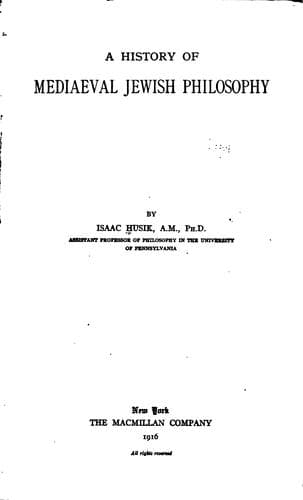
A History of Mediaeval Jewish PhilosophyHusik, Isaac
ReligionJewish
A History of Mediaeval Jewish Philosophy
Husik, Isaac
Philosophy, Jewish; Philosophy, Medieval
Saadia (above p. 28) puts revelation as a fourth source of truth
parallel to sense, judgment and logical inference. To be sure he, in one
instance (p. 35), speaks of the reason as preceding the Bible even as
tradition follows it, but this is only a passing observation, and is
properly corrected by the view expressed elsewhere (p. 28) that while a
Jew is not forbidden to speculate, he must not set the Bible aside and
adopt opinions as they occur to him. Al-Basir does not leave the matter
in this unsettled condition. He definitely gives priority--logical
priority, to reason. Knowledge, he says, must precede revelation. The
prophet as the messenger of God cannot be believed on his word, for the
opponent may have the same claim. Not only must the prophet
authenticate his mission by the performance of a miracle which cannot be
explained by natural means, but we must know besides that he who sent
him has our good at heart and would not deceive us. A knowledge of the
existence, power and wisdom of the creator must therefore precede our
belief in the prophet's mission. To take these truths from the words of
the prophet and then give him credence because God sent him would be
reasoning in a circle. The minimum of knowledge therefore which is
indispensable before we can make any appeal to the words of the prophet
is rational proof of the existence, power and wisdom of God. Having this
minimum the person who is not practiced in speculative investigation may
rely for the rest of the creed, for example, the unity of God and his
other attributes, upon the words of the Bible. For if we know
independently that God is Omnipotent and Omniscient, and the prophet can
substantiate his claim to be a divine messenger by the performance of
genuine miracles, his reliability is established and we are safe in
accepting all that he has to say without proof; but the fundamental
thing to do is to establish the prophet's reliability, and for this an
independent source of evidence is necessary. This is the reason.
Public-domain text, read in full here on John Shaqi.
Reviews
Reviews
No reviews yet
Be the first to share your thoughts on this work.
Elsewhere in the archive
Join the Discussion
Join the discussion
Sign in to leave a comment or review.
Sign InorCreate an account