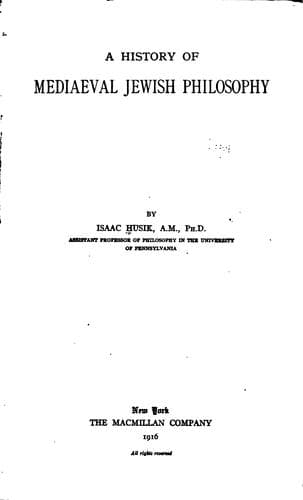
A History of Mediaeval Jewish PhilosophyHusik, Isaac
ReligionJewish
A History of Mediaeval Jewish Philosophy
Husik, Isaac
Philosophy, Jewish; Philosophy, Medieval
Christianity was succeeded in the Orient by Mohammedanism, and this
change led to even greater cultivation of Greek studies on the part of
the Syrians. The Mohammedan Caliphs employed the Syrians as physicians.
This was especially true of the Abbasid dynasty, who came into power in
750. When they succeeded to the Caliphate they raised Nestorian Syrians
to offices of importance, and the latter under the patronage of their
masters continued their studies of Greek science and philosophy and
translated those writings into Syriac and Arabic. Among the authors
translated were, Hippocrates and Galen in medicine, Euclid, Archimedes
and Ptolemy in mathematics and astronomy, and Aristotle, Theophrastus
and Alexander of Aphrodisias in philosophy. In many cases the Greek
writings were not turned directly into Arabic but as the translators
were Syrians, the versions were made first into Syriac, and then from
the Syriac into Arabic. The Syrian Christians were thus the mediators
between the Greeks and the Arabs. The latter, however, in the course of
time far surpassed their Syrian teachers, developed important schools
of philosophy, became the teachers of the Jews, and with the help of the
latter introduced Greek philosophy as well as their own development
thereof into Christian Europe in the beginning of the thirteenth
century.
We see now that the impulse to philosophizing came from the Greeks,--and
not merely the impulse but the material, the matter as well as the
method and the terminology. In the Aristotelian writings we find
developed an entire system of thought. There is not a branch of
knowledge dealing with fundamental principles which is not there
represented. First of all Aristotle stands alone as the discoverer of
the organon of thought, the tool which we all employ in our reasoning
and reflection; he is the first formulator of the science and art of
logic. He treats besides of the principles of nature and natural
phenomena in the Physics and the treatise on the Heavens. He discusses
the nature of the soul, the senses and the intellect in his
"Psychology." In the "History of Animals" and other minor works we have
a treatment of biology. In the Nikomachean and Eudemian Ethics he
analyzes the meaning of virtue, gives a list and classification of the
virtues and discusses the _summum bonum_ or the aim of human life.
Finally in the Metaphysics we have an analysis of the fundamental
notions of being, of the nature of reality and of God.
Public-domain text, read in full here on John Shaqi.
Reviews
Reviews
No reviews yet
Be the first to share your thoughts on this work.
Join the Discussion
Join the discussion
Sign in to leave a comment or review.
Sign InorCreate an account