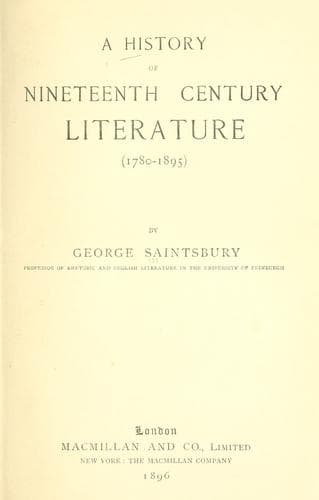
A History of Nineteenth Century Literature (1780-1895)Saintsbury, George
History
A History of Nineteenth Century Literature (1780-1895)
Saintsbury, George
English literature -- 19th century -- History and criticism
Ebenezer Elliott, the "Corn-Law Rhymer," was born in Yorkshire on 7th
March 1781. His father was a clerk in an iron-foundry. He himself was
early sent to foundry work, and he afterwards became a master-founder at
Sheffield. From different points of view it may be thought a
palliation--and the reverse--of the extreme virulence with which Elliott
took the side of workmen against landowners and men of property, that he
attained to affluence himself as an employer, and was never in the least
incommoded by the "condition-of-England" question. He early displayed a
considerable affection for literature, and was one, and about the last,
of the prodigies whom Southey, in his inexhaustible kindness for
struggling men of letters, accepted. Many years later the Laureate wrote
good-naturedly to Wynn: "I mean to read the Corn-Law Rhymer a lecture,
not without some hope, that as I taught him the art of poetry I may
teach him something better." The "something better" was not in Elliott's
way; for he is a violent and crude thinker, with more smoke than fire in
his violence, though not without generosity of feeling now and then, and
with a keen admiration of the scenery--still beautiful in parts, and
then exquisite--which surrounded the smoky Hades of Sheffield. He
himself acknowledges the influence of Crabbe and disclaims that of
Wordsworth, from which the cunning may anticipate the fact that he is
deeply indebted to both. His earliest publication or at least
composition, "The Vernal Walk," is said to date from the very year of
the _Lyrical Ballads_, and of course owes no royalty to Wordsworth, but
is in blank verse, a sort of compound of Thomson and Crabbe. "Love" (in
Crabbian couplets slightly tinged with overlapping) and "The Village
Patriarch" (still smacking of Crabbe in form, though irregularly
arranged in rhymed decasyllables) are his chief other long poems. He
tried dramas, but he is best known by his "Corn-Law Rhymes" and
"Corn-Law Hymns," and deserves to be best known by a few lyrics of real
beauty, and many descriptions. How a man who could write "The Wonders of
the Lane" and "The Dying Boy to the Sloe Blossom" could stoop to
malignant drivel about "palaced worms," "this syllabub-throated
logician," and so forth, is strange enough to understand, especially as
he had no excuse of personal suffering. Even in longer poems the mystery
is renewed in "They Met Again" and "Withered Wild Flowers" compared with
such things as "The Ranter," though the last exhibits the author at both
his best and worst. However, Elliott is entitled to the charity he did
not show; and the author of such clumsy Billingsgate as "Arthur
Bread-Tax Winner," "Faminton," and so forth, may be forgiven for the
flashes of poetry which he exhibits. Even in his political poems they do
not always desert him, and his somewhat famous Chartist (or
ante-Chartist) "Battle-Song" is as right-noted as it is wrong-headed.
Public-domain text, read in full here on John Shaqi.
Reviews
Reviews
No reviews yet
Be the first to share your thoughts on this work.
Elsewhere in the archive
Join the Discussion
Join the discussion
Sign in to leave a comment or review.
Sign InorCreate an account