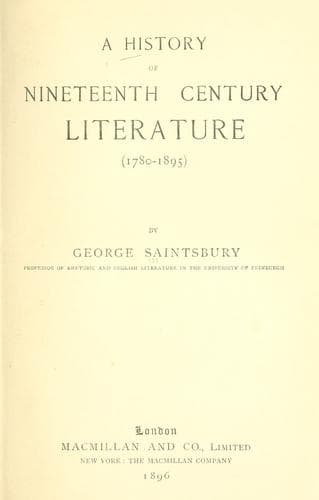
A History of Nineteenth Century Literature (1780-1895)Saintsbury, George
History
A History of Nineteenth Century Literature (1780-1895)
Saintsbury, George
English literature -- 19th century -- History and criticism
younger than Motherwell and lived till 1848, wrote many simple ballads
in the vernacular, of which the most touching are perhaps "The Song of
the Forsaken" and "The Mitherless Bairn."
To return to England, Bryan Waller Procter, who claimed kindred with the
poet from whom he took his second name, was born in 1790, went to
Harrow, and, becoming a lawyer, was made a Commissioner of Lunacy. He
did not die till 1874; and he, and still more his wife, were the last
sources of direct information about the great race of the first third of
the century. He was, under the pseudonym of "Barry Cornwall," a fluent
verse writer of the so-called cockney school, and had not a little
reputation, especially for songs about the sea and things in general.
They still, occasionally from critics who are not generally under the
bondage of traditional opinion, receive high praise, which the present
writer is totally unable to echo. A loyal junior friend to Lamb, a wise
and kindly senior to Beddoes, liked and respected by many or by all,
Procter, as a man, must always deserve respect. If
The sea, the sea, the open sea,
The blue, the fresh, the ever free,
and things like it are poetry, I admit myself, with a sad humility, to
be wholly destitute of poetical appreciation.
The Church of England contributed two admirable verse writers of this
period in Henry Cary and Reginald Heber. Cary, who was born in 1772 and
was a Christ Church man, was long an assistant librarian in the British
Museum. His famous translation of the _Divina Commedia_, published in
1814, is not only one of the best verse translations in English, but,
after the lapse of eighty years, during which the study of Dante has
been constantly increasing in England, in which poetic ideas have
changed not a little, and in which numerous other translations have
appeared, still attracts admiration from all competent scholars for its
combination of fidelity and vigour. Heber, born in 1783 and educated at
Brasenose, gained the Newdigate with _Palestine_, a piece which ranks
with _Timbuctoo_ and a few others among unforgotten prize poems. He took
orders, succeeding to the family living of Hodnet, and for some years
bid fair to be one of the most shining lights of the English Church,
combining admirable parochial work with good literature, and with much
distinction as a preacher. Unfortunately he thought it his duty to take
the Bishopric of Calcutta when it was offered him; and, arriving there
in 1824, worked incessantly for nearly two years and then died. His
_Journal in India_ is very pleasant reading, and some of his hymns rank
with the best in English.
Public-domain text, read in full here on John Shaqi.
Reviews
Reviews
No reviews yet
Be the first to share your thoughts on this work.
Elsewhere in the archive
Join the Discussion
Join the discussion
Sign in to leave a comment or review.
Sign InorCreate an account