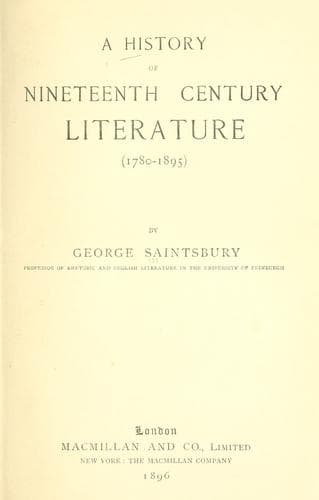
A History of Nineteenth Century Literature (1780-1895)Saintsbury, George
History
A History of Nineteenth Century Literature (1780-1895)
Saintsbury, George
English literature -- 19th century -- History and criticism
that these ten lines contain more pure poetry than the entire works of
Byron. And the same touch will be found not merely in the "Wolfram
Dirge" mentioned--
If thou wilt ease thine heart
Of Love and all its smart,
Then sleep, dear, sleep.
...
But wilt thou _cure_ thine heart
Of Love and all its smart,
Then die, dear, die--
but in several other dirges (for the dirge is the form natural to
Beddoes), in the "Song from Torrismond," in "Love in Idleness," in the
"Song on the Water" (which is pure early Tennyson), in the exquisite
"Threnody," and in many other things. They have been called artificial:
the epithet can be allowed in no other sense than in that in which it
applies to all the best poetry. And they have the note, which only a few
true but imperfect poets have, of anticipation. Shadows before, both of
Tennyson and Browning, especially of the latter, appear in Beddoes. But
after all his main note is his own: not theirs, not the Elizabethan, not
Shelley's, not another's. And this is what makes a poet.
As Beddoes' forte lay in short and rather uncanny snatches, so that of
Richard Hengist Horne lay in sustained and dignified composition. He was
not christened Hengist at all, but Henry. He had a curious life. In
youth he knew Keats and Wells, having been, like them, at the private
school of Mr. Clarke at Edmonton. He went to Sandhurst and was expelled
for insubordination; joined the Mexican navy in the war of liberation;
travelled widely; but seemed at about five and twenty to be settling
down to literature and journalism in England. After writing various
things, he produced in 1837 the fine but not quite "live" plays of
_Cosmo de Medici_ and _The Death of Marlowe_, and in 1843 the famous
farthing epic, _Orion_, which was literally published at a farthing.
This was the smallest part of a great literary baggage of very unequal
value. In 1852 Horne, resuming the life of adventure, went to Australia,
served in the gold police, and stayed at the Antipodes till 1869. Then
he came home again and lived for fifteen years longer, still writing
almost to his very death on 13th March 1884.
Public-domain text, read in full here on John Shaqi.
Reviews
Reviews
No reviews yet
Be the first to share your thoughts on this work.
Elsewhere in the archive
Join the Discussion
Join the discussion
Sign in to leave a comment or review.
Sign InorCreate an account