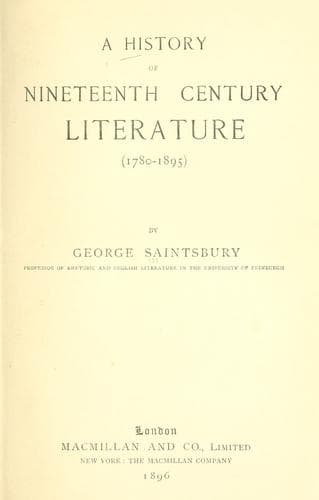
A History of Nineteenth Century Literature (1780-1895)Saintsbury, George
History
A History of Nineteenth Century Literature (1780-1895)
Saintsbury, George
English literature -- 19th century -- History and criticism
It is not true that _Orion_ is Horne's only work of value; but it is so
much better than anything else of his, and so characteristic of him,
that by all but students the rest may be neglected. And it is an example
of the melancholy but frequently exemplified truth, that few things are
so dangerous, nay, so fatal to enduring literary fame, as the production
of some very good work among a mass of, if not exactly rubbish, yet
inferior stuff. I do not think it extravagant to say that if Horne had
written nothing but _Orion_ and had died comparatively young after
writing it, he would have enjoyed very high rank among English poets.
For, though doubtless a little weighted with "purpose," it is a very
fine poem indeed, couched in a strain of stately and not second-hand
blank verse, abounding in finished and effective passages, by no means
destitute of force and meaning as a whole, and mixing some passion with
more than some real satire. But the rather childish freak of its first
publication probably did it no good, and it is quite certain that the
author's long life and unflagging production did it much harm.
Of the other persons in the list above, Macaulay, Hartley Coleridge, and
Lord Lytton are mainly something else than poets, and Talfourd, as a
dramatist, will also be noticed elsewhere. Barnes and Hawker were both
clergymen of the West of England: the former very highly ranked by some
for his studies in Dorset dialect; the latter the author of the famous
"Song of the Western Men" (long thought a genuine antique), of the
exquisite "Queen Gwennyvar's Round," of the fine "Silent Tower of
Bottreaux," of some beautiful sonnets, and of the stately "Quest of the
Sangreal." Whether James Clarence Mangan, whose most famous poem is
"Dark Rosaleen," a musical and mystic celebration of the charms and
wrongs of Erin, is a great poet to whom Saxon jealousy has refused
greatness for political reasons, or a not ungifted but not consummately
distinguished singer who added some study to the common Irish gift of
fluent, melodious verse-making, is a question best solved by reading his
work and judging for the reader's self. It is not by any sane account so
important that to dismiss it thus is a serious _rifiuto_, and it is
probably impossible for Irish enthusiasm and English judgment ever to
agree on the subject. Of "L. E. L." Sir Henry Taylor, Hood, and Praed,
some more substantive account must be given.
Public-domain text, read in full here on John Shaqi.
Reviews
Reviews
No reviews yet
Be the first to share your thoughts on this work.
Elsewhere in the archive
Join the Discussion
Join the discussion
Sign in to leave a comment or review.
Sign InorCreate an account