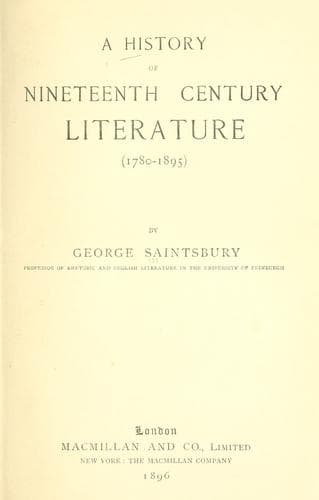
A History of Nineteenth Century Literature (1780-1895)Saintsbury, George
History
A History of Nineteenth Century Literature (1780-1895)
Saintsbury, George
English literature -- 19th century -- History and criticism
nineteenth, of whom Miss Austen is the first. This is not merely,
though no doubt it is partly, due to the fact that the society which she
saw (and she mixed in a great deal, from the highest downwards) was
itself in a kind of transition state: it was at least as much owing to a
certain want of distinct modernness and distinct universality in her own
character, thought, and style. Miss Edgeworth, though possessed of
delightful talents falling little short of genius, and of much humour
(which last is shown in the charming _Essay on Irish Bulls_, as well as
in her novels and her letters), missed, as a rule, the last and greatest
touches; and, except some of her Irish characters, who are rather types
than individuals, she has not created many live persons, while sometimes
she wanders very far from life. Her touch, in short, though extremely
pleasant, was rather uncertain. She can tell a story to perfection, but
does not often invent it perfectly; and by herself she can hardly be
said to have originated anything, though of course, if we could accept
the above quoted statement of Scott's, she indirectly originated a very
great deal.
Very different is the position occupied by Jane Austen, who was born at
Steventon in Hampshire on 16th December 1775, being the daughter of the
rector of that place, lived a quiet life chiefly at various places in
her native county, frequented good society in the rank of not the
richest country squires, to which her own family belonged, and died at
Winchester unmarried on 24th July 1817. Of her six completed novels,
_Sense and Sensibility_, _Pride and Prejudice_, _Mansfield Park_, and
_Emma_ were published during the last seven years of her life, while
_Northanger Abbey_ and _Persuasion_ appeared, for the first time with an
author's name, the year after her death. They had no enormous or sudden
popularity, but the best judges, from Scott downwards, at once
recognised their extraordinary merit; and it is not too much to say that
by the best judges, with rare exceptions, that merit has been
acknowledged with ever increasing fulness at once of enthusiasm and
discrimination to the present day. With Scott, Miss Austen is the parent
of nineteenth century fiction; or, to speak with greater exactness, she
is the mother of the nineteenth century novel, just as he is the father
of the nineteenth century romance.
Public-domain text, read in full here on John Shaqi.
Reviews
Reviews
No reviews yet
Be the first to share your thoughts on this work.
Elsewhere in the archive
Join the Discussion
Join the discussion
Sign in to leave a comment or review.
Sign InorCreate an account